Gadaa Michillee Clan of Karrayyu Commences Historic “Cidha Buttaa” Ceremony
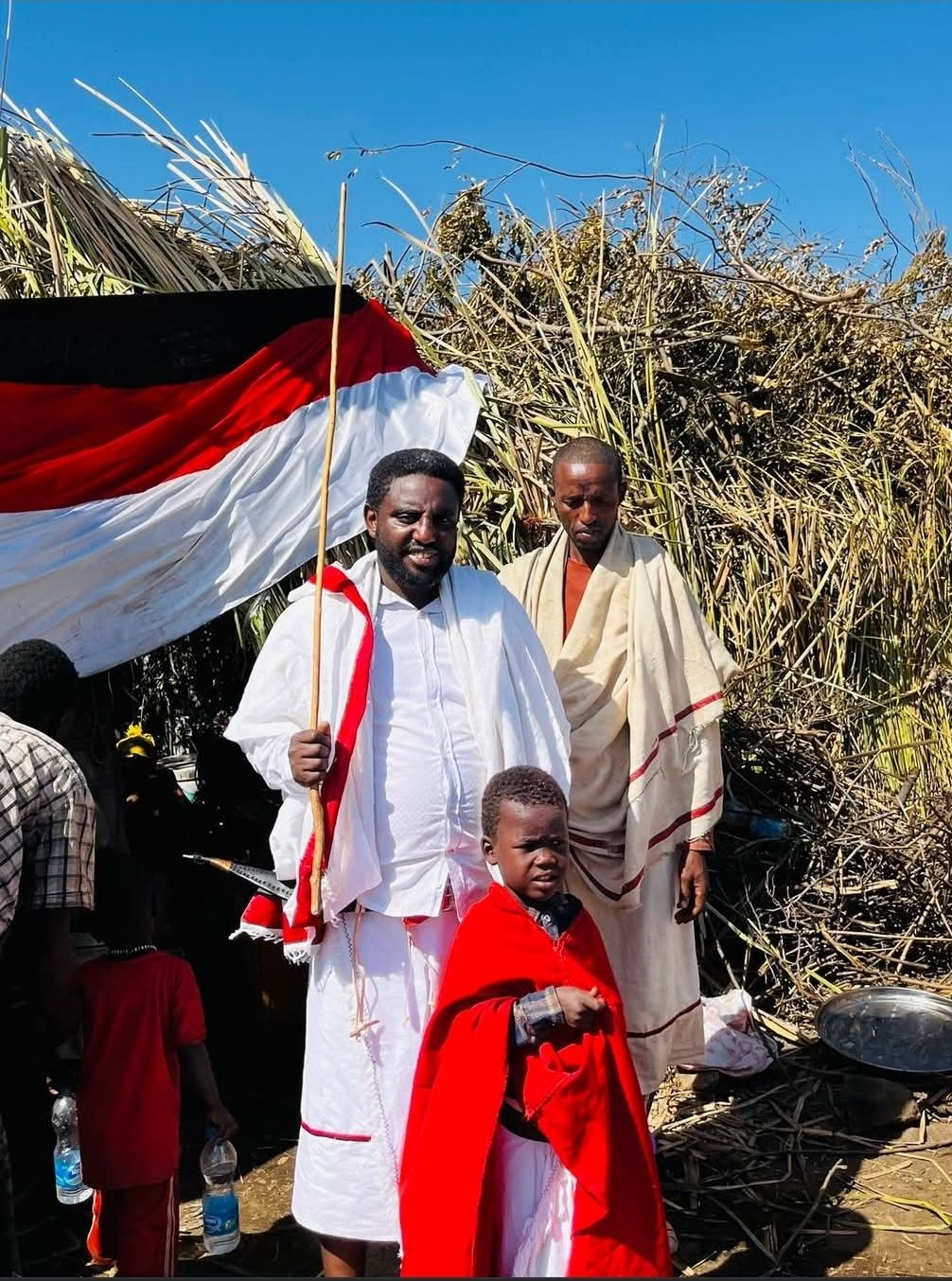
Muddee 26, 2025 — The esteemed Gadaa council of the Michillee clan within the Karrayyu Oromo nation has officially inaugurated the grand Cidha Buttaa ritual at Tarree Leedii, marking the beginning of a profound 12-day cultural and spiritual observance. The ceremony, which began on the 26th of Muddee (December), is set to conclude with major rites on the 26th and 27th.
The Cidha Buttaa is a complex sequence of traditional rites performed in a strict, consecutive order over its duration. The opening days have seen powerful foundational ceremonies:
Day 1 (Muddee 26):
- The Gadaa council members formally took their designated seats (Tarree Leedii).
- The sacred fire at the Abbaa Bokkuu’s (leader’s) hut was ignited.
- Blessing rituals (Eebbaa) were performed.
- A ritual of communion and sharing of ceremonial drink (Qubsuma) was held.
- Camels (Geejjiba) were paraded in a display of honor and strength.
- At Tulluu Huffeenna, a Kataarii tree was erected and burned, with prayers for abundance (Korbeessa Huffeenaa).
- The Raabaa officials conducted rituals involving a ceremonial staff (Dhaddacha) and the planting of a ritual stake (Ardaaga).
Day 2 (Muddee 27):
- A mature bull (Dullacha) was sacrificed at the entrance of the leader’s hut.
- Vigil was kept over the sacred fire and the Ardaaga stake.
From the third to the fifth day (Muddee 28-30), the focus shifted to construction: building the main ritual lodge (Galma), installing the central ritual object (Daasa Keessummaa), and constructing enclosures for cattle and camels.
The period from the fifth to the ninth day (Muddee 30-Amajjii 3) involves spiritual and communal deliberations:
- Pilgrimages to sacred sites like Uman, hills, and valleys.
- Prayers for peace to Waaqa (the Creator).
- A series of assemblies to discuss the preservation and transmission of Gadaa laws, customs, and clan identities.
- Deliberations on environmental stewardship and land protection.
All these preparatory rituals will lead to the climactic ceremonies on the tenth day.
Day 10 (Amajjii 6):
- At dawn, the final preparations (Hiiddii) will be made.
- A special shelter (Bitimaa) will be erected behind the cattle enclosure.
- In the afternoon, the Abbaa Galmaa (ceremony head) will stand before the shelter to formally authorize the appointed ritual actors (Gumaachitoota).
The Cidha Buttaa will then enter its final, most sacred phase on the night of the 6th of January, continuing into the 7th of January.
This elaborate ceremony reaffirms the vitality of the Gadaa system, serving as a critical mechanism for cultural renewal, social cohesion, spiritual blessing, and the intergenerational transfer of authority and knowledge among the Karrayyu Oromo.
The Calculated Return: Rebranding Hassan Ali and the Politics of Historical Amnesia
By Koste Abdiisaa (Political Commentary)

Since last week, a familiar yet troubling political theatre has unfolded on our social media feeds. The return of former Oromia president Mr. Hassan Ali has been met not with sober reflection, but with a coordinated campaign of glorification. The volume and tenor of this noise are not organic; they are a political product. And they demand a critical question: Why the aggressive, sudden need to rewrite a man’s past?
Let us be clear: the return of any individual is, in itself, a neutral event. What is not neutral is the systematic attempt to whitewash a deeply problematic political record against the backdrop of profound, ongoing suffering. Mr. Hassan Ali, like millions of Oromos, was once a vocal critic of the very system he later led. Yet, his presidency under the OPDO—the regional arm of the then-ruling EPRDF—was not a period of liberation. It was a chapter in the same grim story of state-sanctioned violence against the Oromo people.
Historical memory cannot be deleted by a hashtag. It was under the governance structure he led that figures like Nadhii Gammadaa, Dararaa Kafanii, and Jireenyaa Adunyaa were executed or forcibly disappeared. It was a system that normalized imprisonment, exile, and death for countless innocent Oromos. To launch a social media campaign that glosses over this reality is not just revisionism; it is an insult to the victims and their families who still seek justice.
Therefore, the fixation on whether he is being praised misses the point. The urgent questions are strategic and forward-looking:
- Why now? Why has the Prosperity Party (PP) and the Shimelis Abdisa administration chosen this precise moment to facilitate and amplify his return? Is it coincidental that this occurs amid escalating political and security crises in Oromia and other regions?
- What is the political calculus? The PP is not a charitable organization. Its every move is tactical. Is Hassan Ali’s return intended as a distraction, a shiny object to divert public attention from state failures? Is it an attempt to create a semblance of “reconciliation” with a discredited faction to split opposition sentiment? Or, more cynically, is it the first move in grooming him as a “reformed” candidate for a future managed election, providing a veneer of Oromo leadership while serving PP’s centralist agenda?
- Who benefits from the noise? The sheer volume of orchestrated praise serves to drown out these very questions. It aims to replace critical analysis with emotional reception, shifting the narrative from accountability to celebrity.
History offers a clear lesson: the political machinery Hassan Ali once served has never acted without cold, strategic intent. Invitations back into the fold are extended not as acts of grace, but as moves on a chessboard.
My apprehension is not personal. It is political. At this stage of his life, one hopes Mr. Hassan Ali would seek a legacy of truth, not convenience. To become a pawn in a strategy designed to legitimize a system that continues to oppress his own people would be to stand, once more, on the wrong side of history.
Ultimately, the Oromo struggle for justice, self-determination, and dignity is larger than any individual. It will not be derailed by a rebranding campaign or short-term political maneuvering by the PP. The people’s quest for accountability is relentless.
However, for the individual, history offers a space for reflection and correction. The most consequential mistakes are often those we repeat. The real test is whether this return is a step toward genuine atonement and independent voice, or whether it is a political trap—for him, and a painkiller for a government under pressure. Only time will reveal the true diagnosis, but we must not let the noise of the moment silence our critical inquiry. The past is prologue, and ignoring its lessons is a luxury the Oromo nation can no longer afford.
Remembering Aayyoo Asinaa Abduramaan: A Legacy of Strength

A Pillar of the Struggle Departs: Mourning the Passing of Aayyoo Asinaa Abduramaan, Mother of Jaal Hundee Daraaraa
The Oromo global community is in mourning following the passing of Aayyoo Asinaa Abduramaan, a revered matriarch and steadfast symbol of resilience, who died today after a prolonged illness. Her departure marks not just a personal loss for her family, but a profound moment of collective grief for a nation that saw in her the unbreakable spirit of Oromo motherhood.
Aayyoo Asinaa was more than a mother; she was an expert in life and a mother of freedom fighters. She lived a life defined by immense sacrifice and unwavering dedication to the cause of Oromo liberation. While her own children dedicated their lives to the struggle, she bore the heaviest of burdens, suffering the ultimate loss and enduring hardship without complaint.
She was the mother of Jaal Hundee Daraaraa (MGS_ABO), a freedom fighter of the Oromo Liberation Front (OLF). In the pursuit of Oromia’s freedom, she gave her sons, experiencing both the pain of their loss and the suffering of those who returned bearing the scars of battle. She endured these trials with a heart that remained a source of strength for others, even as her own body and spirit carried wounds that never fully healed.
A Personal Testament to Her Strength
A community member who witnessed her fortitude firsthand shared a poignant memory: “I saw Aayyoo Asinaa for the first time in 2018 when OLF leadership returned to the country. During a public event in Ghindhir town, as leaders addressed the crowd in the South-East region, she saw Jaal Hundee Daraaraa. Remembering her son, lost in the struggle for so many years, she collapsed in tears. It was a heartbreaking scene. She was a consoler of others, a mother of fighters, and a heroine who displayed exceptional grace for Oromia. Her passing leaves a deep ache in our hearts.”
Her life story embodies the quiet, often overlooked, heroism of mothers in liberation movements—those who send their children to the front lines and must find a way to live with the consequences, becoming pillars for their communities while nursing private grief.
A Legacy of Sacrifice and Strength
Aayyoo Asinaa Abduramaan’s legacy is one of profound sacrifice and unyielding dignity. She navigated a path of personal tragedy without allowing bitterness to overshadow her love for her people and their cause. Her life was a testament to the Oromo proverb that true strength is often found in silent endurance.
The community now rallies around her remaining family, offering prayers for strength and unity. “May God grant her mercy,” the statement concluded. “May He provide patience, solace, and resilience to Jaal Hundee and the rest of the family.”
As news of her passing spreads under the hashtag #AayyooAsinaaAbduramaan, social media is filling with tributes, honoring a woman whose name will be remembered alongside the freedom fighters she raised and supported—a true Aayyoo (revered mother) of the nation.
Rest in Power, Aayyoo Asinaa. Your struggle is now your eternal peace.
The Unquenchable Flame: Amajjii and the Living Memory of Oromo Resistance

By Dhabessa Wakjira
OROMIA – Across the highlands and valleys of Oromia, and within diaspora communities spanning the globe, the Oromo people are preparing to observe Ayyaana Amajjii—a day that is far more than a cultural anniversary. It is a living chronicle of resistance, a solemn vow of continuity, and a beacon of collective identity lit against a backdrop of enduring struggle. As one message proclaims: “AYYAANA AMAJJII BAGA GEESSAN!” – “Happy Amajjii Holiday!”
Celebrated for over 40 years, Amajjii commemorates a pivotal historical moment of defiance. Its roots lie in “a history of resilience in the Oromo freedom struggle and the heroism of Oromo fighters,” a day when a courageous few secured a landmark victory against formidable enemies. This singular event is etched into the Oromo consciousness not merely as a past triumph, but as an eternal wellspring of strength.
“Amajjii is a symbol of the endurance and perseverance that defines our entire struggle,” explains a community historian. “It is a holiday that surpasses all others, a flame we keep alive to illuminate the path to Oromo freedom from within the darkness of oppression.”
This year, the commemoration carries a particularly profound weight. The community gathers in what is described as “a time of difficulty and darkness,” marked by reports of severe hardship, drone strikes, militia violence, and widespread military crackdowns. “This brutal oppression wounds us,” the message states, “but without losing hope, we resist fiercely and honor our Amajjii, learned from our ancestors.”
It is precisely in such moments of intensified pressure, the tradition holds, that the history of Amajjii becomes most vital. The day serves as a crucial space—a sanctuary in time—to reaffirm unity, recommit to the quest for a dignified and egalitarian society, and honor the foundational values of respect and justice. The ceremony itself is a multi-faceted lesson in the Oromo liberation narrative.
The central, unifying ritual is the lighting of the Amajjii bonfire atop the highest hill. This “Xomboorrii Amajjii” is far more than a fire; it is the primary symbol of Oromo freedom. As its flames climb skyward, it is seen as broadcasting a powerful message: a message of true liberty, of emerging from subjugation, of unbreakable hope rising from the ashes of despair, and of light piercing a profound darkness.
“Amajjii is the day we remember the Oromo freedom fighters who sacrificed their lives without hesitation to liberate and protect Oromia and its people,” the commemoration note affirms. This act of remembrance is inextricably linked to the deep Oromo tradition of honoring elders and pioneers—those who preserve culture, offer guidance, and advocate for justice. Amajjii is, in essence, the national-scale enactment of this duty of respect.
The 2026 observance is therefore framed not just as a look backward, but as a strategic reaffirmation for the future. It is a time to “renew our pledge” to continue the struggle, bolstered by the conviction that Oromia will ultimately be a place where rights are asserted and the Oromo nation is honored in its unity and freedom.
From the ancestral hills of Oromia to community centers worldwide, the lighting of the Amajjii fire this year will be a potent, silent, and luminous declaration. It asserts that memory is resistance, that collective ceremony is a form of resilience, and that an unquenchable flame, passed down through generations, continues to light the way forward.
AYYAANA AMAJJII GAARII! – A dignified Amajjii to all!
Oromo Studies Association Remembers Professor Hamdeessaa Tusoo

Oromo Studies Association (OSA) Mourns the Passing of Professor Hamdeessaa Tusoo
The Oromo Studies Association (OSA) has expressed its profound sorrow upon the passing of the esteemed scholar and activist, Professor Hamdeessaa Tusoo.
In an official statement, OSA remembered Professor Hamdeessaa not only as a brilliant Oromo intellectual but also as a founding member who played an indispensable role in the establishment of the association. The statement emphasized that his contributions to the fields of Oromo scholarship and the global academic community were truly immeasurable.
The association highlighted his pivotal leadership from the very beginning, noting that he served as its first president and laid a strong foundation for the organization. This was at a critical time in 1986 when Oromo history, knowledge, and culture were under significant pressure. Professor Hamdeessaa provided crucial leadership and made immense contributions to building a robust institution dedicated to critical inquiry, intellectual empowerment, and collective advancement.
OSA’s statement further detailed the professor’s lifelong dedication. Born and raised in Oromia, he waged a long and steadfast struggle for the rights, dignity, and freedom of the oppressed Oromo people.
His commitment to the Oromo cause was evident early on; while in secondary school, he began his activism in human rights, demonstrating an unwavering sense of justice and a spirit of self-sacrifice for the goals of his people. These early experiences set the tone for a life dedicated to scholarship, mentorship, and public service.
After earning his Ph.D. from Michigan State University in 1981, Professor Hamdeessaa held significant academic positions at numerous prestigious institutions, including George Mason University, Antioch University, Nova Southeastern University, Menno Simons College, and the University of Manitoba.
His scholarly work was robust, focusing on critical areas such as peace and conflict, indigenous peacemaking, African oral traditions, and the politics of the Horn of Africa.
Beyond the academy, OSA noted, Professor Hamdeessaa Tusoo also played a major role in community service and empowerment, leaving a legacy that extends far beyond the classroom.
Oromo Story
The Oromo Story: A Living Tradition of History, Myth, and Memory
An “Oromo story” embodies the vast and vibrant tapestry of oral traditions, historical narratives, and collective experiences of the Oromo people, the largest ethnic group in Eastern Africa. Primarily inhabiting Ethiopia and northern Kenya, the Oromo have preserved their identity through a powerful oral culture, passing down through generations a rich heritage of myths, legends, folktales, and biographies of pivotal figures.
Historical and Cultural Narratives
These stories are deeply rooted in the Oromo experience as pastoralists and agriculturalists, chronicling their history of resilience against marginalization and their enduring efforts to safeguard a unique cultural identity. The narratives weave together epic events like the Great Oromo Migrations, the evolution of the sophisticated Gadaa system of democratic governance, the spiritual beliefs of Waaqeffanna, and the profound rites of passage that mark a lifetime—from birth and marriage to funeral ceremonies.
Exemplar: The Tale of Hawecha the Dreamer
A quintessential story from this tradition is that of Hawecha, a revered prophetess who lived two centuries ago. In an era dominated by male leadership, Hawecha emerged as a central spiritual figure, renowned for her prophetic dreams. Her visions, which foretold wars, famines, and epidemics, remain a celebrated part of Oromo folklore, underscoring the vital role of women’s wisdom and mystical insight. The enduring legacy of Hawecha’s story serves to inspire and guide the community, reflecting core Oromo values of prophecy, collective well-being, and resilience.
Stories of Struggle and Survival
The Oromo narrative tradition also gives voice to profound historical trauma, including the harrowing accounts of Oromo children enslaved in the late 19th century. Preserved in autobiographical records, these stories transform past suffering into a testament of survival, offering critical insight into the unyielding endurance of Oromo identity despite forced displacement and immense hardship.
Enduring Themes in Oromo Stories
Across this diverse body of work, several powerful themes resonate:
· The central importance of community and familial bonds.
· A deep reverence for ancestors, the natural world, and spiritual beliefs.
· Foundational lessons in justice, resilience, and ethical leadership.
· The crucial preservation of language and collective memory through oral tradition.
More than mere tales, Oromo stories are the vital vessels of identity, cultural values, and shared aspirations. They are the living thread that sustains cultural continuity, ensuring the survival of the Oromo spirit through centuries of challenge and change.

