Abbabach Gobena:The Woman Who Became a Mother to Millions Orphanage and beyond.
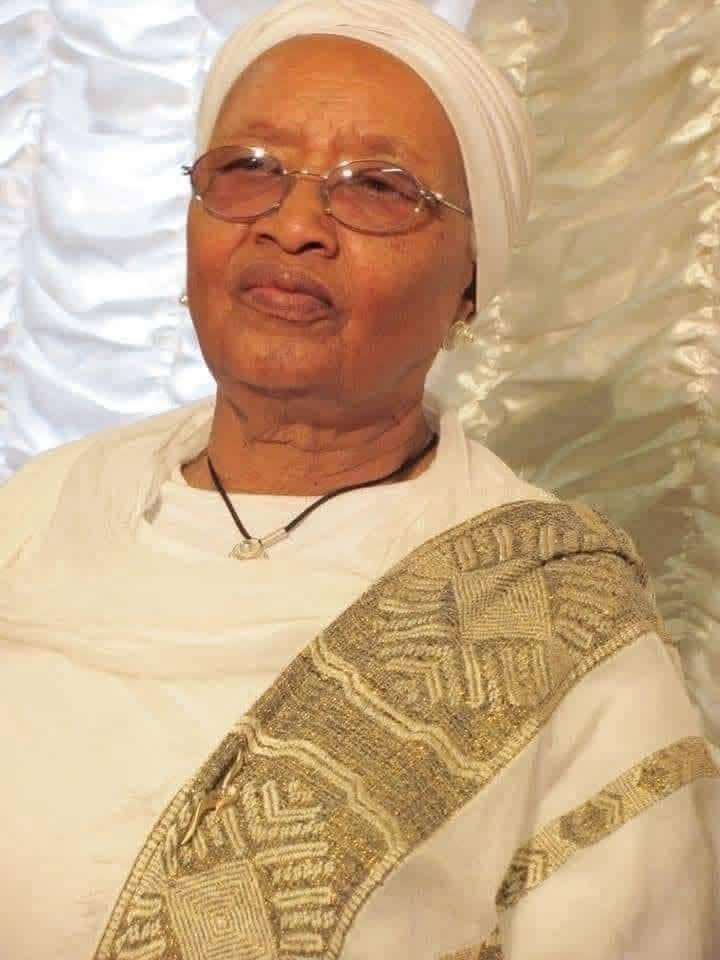
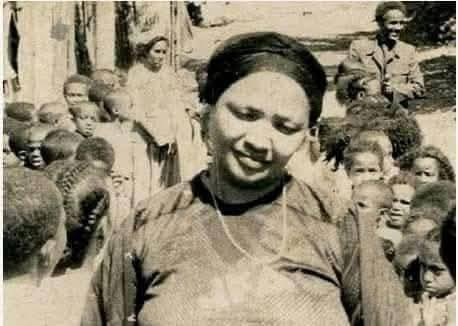
From the pain of famine to a lifetime of compassion — the remarkable journey of the Ethiopian woman known as Africa’s Mother Teresa, who gave hope, dignity, and a future to more than a million orphaned children.
Abbabach Gobena – The Mother Teresa of Africa lost her father during the period of the Italian occupation of Abyssinia/ Ethiopia/. At the age of ten, she was forced into marriage. Refusing to accept a life decided for her, she fled and made her way to Finfine /Addis Ababa/. In the city she struggled to rebuild her life, pursued her education with determination, and eventually secured a stable job.
Abbabach was a woman of deep faith. Her spiritual life guided her actions and shaped her character. She loved God deeply and placed great trust in her faith. During the Derg era, around 1980, she undertook a spiritual pilgrimage to Gishen Mariam, one of Ethiopia’s most sacred religious sites.
After completing the pilgrimage and beginning her journey back to Addis Ababa, she passed through Wollo, which at the time was suffering from a devastating famine. What she witnessed there changed the direction of her life forever.
She saw people dying from hunger. Families had been destroyed by starvation, and countless children had been left without parents. Among the heartbreaking scenes she encountered was a small child trying to breastfeed from his mother who had already died from hunger. The child, unaware of death, was still desperately searching for milk from a lifeless body of his mother.
When Abbabach saw this scene, she was deeply shaken. She could not walk away. Overcome with compassion, she picked up the child and took him with her. At that moment, the only thing she possessed was a small bottle of holy water she had brought from Gishen. Yet despite having almost nothing, she made a life-changing decision. She began caring for children who had lost their parents to famine and hardship.
Abbabach started raising orphaned children with whatever means she could find. She worked tirelessly, taking on different kinds of labor to support them. Within just one year, she had already taken in 21 children.
What began as a single act of compassion gradually grew into a lifelong mission. Over the course of her life, Abbabach Gobena went on to rescue, support, and educate more than 1.5 million children. She helped them grow, receive education, and become self-reliant members of society.
Today, her extraordinary life continues to inspire people across Ethiopia and beyond. In honor of her legacy, a film titled “Adaraa Abbabach” has been produced to tell the story of this remarkable woman who became a mother to millions. Plans are also underway to establish a hospital bearing her name so that her service to humanity may continue in new forms.
The name Abbabach Gobena has become a symbol of compassion, faith, honesty and sacrifice.Yet remembering her name alone is not enough. The greatest tribute to her life is to continue the work she began — caring for the vulnerable, protecting children, and standing with those in need.
This week we renew our commitment to the legacy of Abbabach Gobena. By learning about the work done in her name and contributing in whatever way we can, we carry forward the promise she made through her life.
May God help us succeed in continuing her mission.
Commentary: Of Elders, Apologies, and the Weight of Generational Debt
By Daandii Oromia
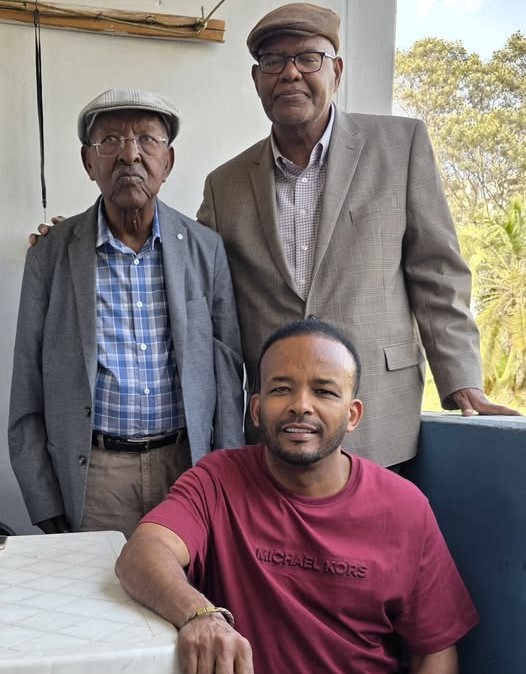
There is a photograph circulating on social media this week. In it, a young man sits at the feet of elders. His head is bowed slightly. The elders regard him with the mixture of suspicion and tenderness that only old men can muster when they look at the young.
The man is Habtamu Lamu. And he has done something remarkable: he has apologised.
“I represent my generation,” he wrote. “I have asked forgiveness from our elders.”
It is a simple act. But in a cultural landscape where elders are too often dismissed as obstacles rather than honoured as anchors, it carries the weight of centuries.
The weight of what was taken
Habtamu’s apology was not generic. It was directed specifically at those who carried the struggle for Oromo liberation through its darkest decades—veterans like the venerable intellectual Leenco Lata and former Oromia President Hasan Ali Waaqayyo.
“Sitting at the feet of elders, I learned many things,” Habtamu wrote. “May God grant them long life.”
One does not need to agree with every political position these men have ever taken to recognise what they represent. They are living archives. They carry within their bones the memory of what was done to the Oromo people, and the memory of what was done by Oromo people in the long march toward dignity.
Leenco Lata, in particular, embodies a certain kind of Oromo intellectual tradition—rigorous, uncompromising, and deeply rooted in the soil of his people’s experience. His writings on Oromo political history are not mere academic exercises; they are acts of preservation, ensuring that a generation born after the struggle understands what came before.
The rejoinder: who owes what to whom?
But no act of public apology goes unanswered in our times. Enter Magaada Boruu, whose response cuts against the grain of Habtamu’s humility.
“We, this generation, have nothing to apologise for,” he wrote. “If anything, we have been imprisoned and tortured ourselves, while they returned to their properties and prospered! Ashqaabbaxuunis hanguma obboo Gingilshaa”
The emojis do not disguise the anger beneath the words. Magaada Boruu speaks for a generation that watched many of the old guard return from exile to reclaim houses and land while young activists filled prisons. He invokes the name of Gingilshaa—the Oromo revolutionary flame—as witness to his claim.
And he is not entirely wrong.
There is a painful asymmetry in the Oromo experience of the past decade. Some elders returned to comfortable retirements. Some young people returned to torture chambers. The revolution devoured its children even as it elevated its patriarchs.
The dialectic of debt
Between Habtamu’s apology and Magaada’s rejection lies the full complexity of Oromo politics today.
Habtamu recognises something true: that generations build upon generations, that no struggle begins in a vacuum, that the young walk paths carved by the old through bush and briar. There is dignity in acknowledging that debt.
Magaada recognises something equally true: that debt can be claimed fraudulently, that suffering is not evenly distributed across generations, that some elders used the young as cannon fodder while securing their own exits. There is justice in demanding accountability.
The danger is that these two truths become mutually exclusive—that the young refuse all honour to the old, or that the old demand all honour from the young without examination of their own compromises.
Sitting at the feet
Habtamu’s photograph captures something worth preserving: a young man choosing to sit rather than to stand, to listen rather than to speak, to honour rather than to dismiss.
In Oromo tradition, the jaarsummaa—the council of elders—is not merely a social institution but a philosophical one. It rests on the understanding that wisdom accumulates slowly, that no single generation possesses all truth, that the young who do not sit at the feet of elders will eventually have no feet to sit at.
But elders, too, have obligations. The feet at which the young sit must be feet that walked toward justice, not away from it. The wisdom imparted must be wisdom tested by experience, not merely authority asserted by age.
The long road
The Oromo struggle has always been a relay race across generations, not a sprint within them. The baton passes from those who fought with the pen (like Leenco Lata), to those who fought with the gun, to those who fight now with keyboards and courage and the willingness to fill prisons.
Each generation stumbles. Each generation falls short. Each generation imagines itself the first to truly understand what is required.
And each generation must decide whether it will honour what came before while building what must come after—or whether it will burn down the past in the name of a future it cannot yet see.
Habtamu has chosen to honour. Magaada has chosen to question.
Perhaps both are necessary. Perhaps the Oromo people need young people who sit at the feet of elders and young people who demand that those elders account for what they did while sitting in comfort.
But in the photograph, the young man sits. The elders look at him. And something passes between them that cannot be captured in Facebook comments or Twitter threads—something older than politics, deeper than grievance, more enduring than any single generation’s anger.
It is simply this: the recognition that we belong to each other across time, that the debt runs both ways, that apology and accountability are not opposites but partners in the long work of becoming a people worthy of our ancestors and our descendants.
May God grant long life to those who carry memory. May God grant courage to those who carry struggle. And may God grant wisdom to all of us who must somehow do both at once.
The views expressed in this commentary are those of the author and do not necessarily reflect the positions of any organisation or institution.
Colonel Gammachuu: The Unyielding Truth Teller of Oromia
Title: The Unbent Reed: A Commentary on Colonel Gammachuu Ayyaanaa and the Cost of Truth
By Maatii Sabaa
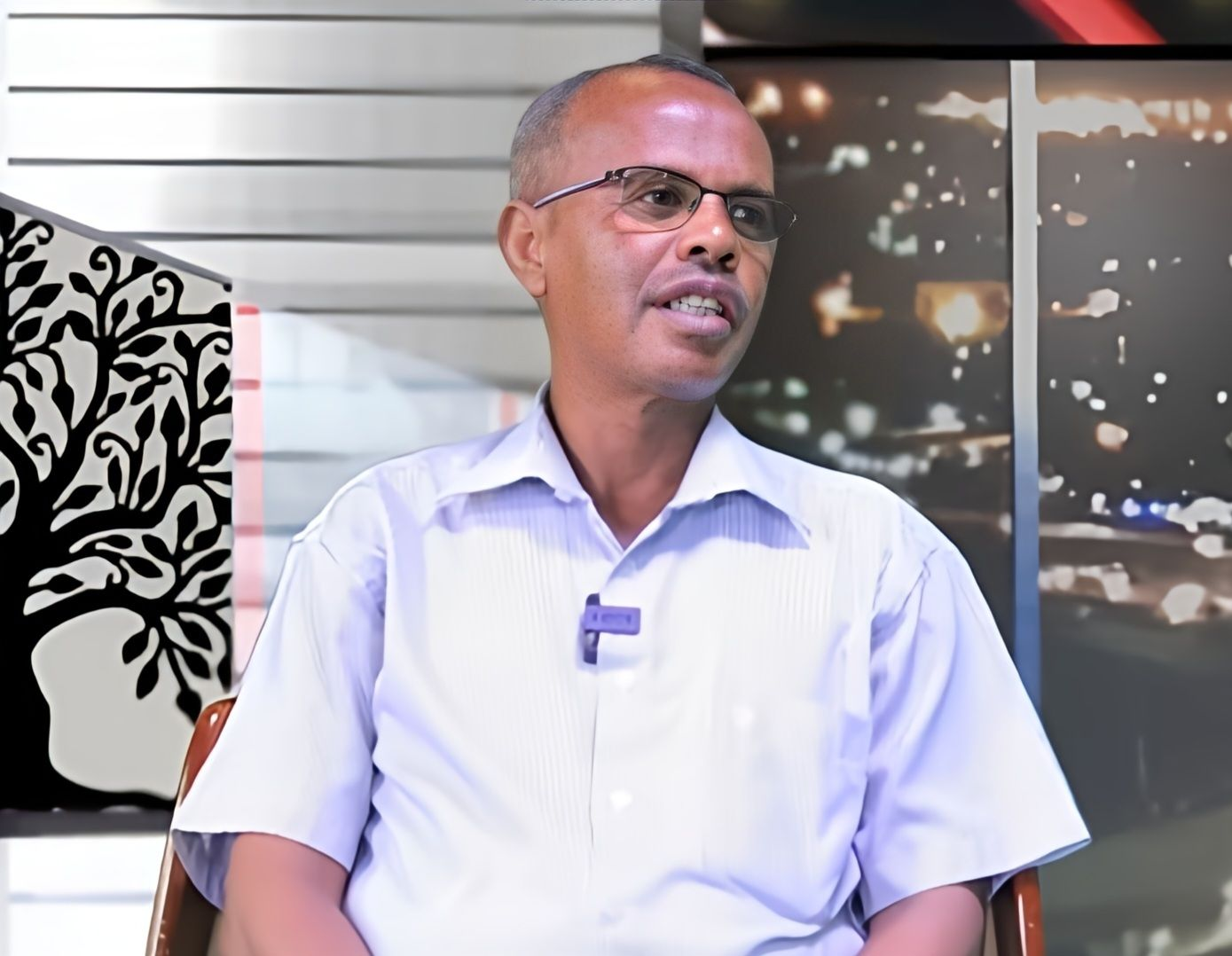
In the suffocating political atmosphere of empires, where silence is often traded for security and allegiances are bartered for comfort, a singular figure stands apart not for the power he wields, but for the truth he refuses to relinquish. Colonel Gammachuu Ayyaanaa, as profiled in a recent and fervent tribute, is presented not merely as a man, but as a phenomenon—an unbent reed in a storm of compromise. He embodies a rare and dangerous archetype: the native son who, understanding the inner workings of the Ethiopian imperial system, chooses not to dine at its table but to speak its crimes aloud.
The commentary paints him with the brush of absolute conviction. He is a man who “knows no malice” and “speaks no falsehood.” This is his foundational identity. In a landscape riddled with coded language and strategic ambiguity, his clarity is itself a revolution. He does not speak truth as a strategy for a better personal life; indeed, his truth-telling guarantees the opposite. As the piece starkly notes, he has “no private life,” existing instead in a state of “lowly livelihood.” The trade-off is explicit: his comfort for his people’s cause. What worries him is not personal hardship, but the “encroachment on the rights of the Oromo people and the violation of Oromia’s borders.”
This is where Gammachuu transcends the typical political or military figure. He is portrayed not as a commander giving orders from a safe remove, but as a “dhaabee”—one who is stationed, rooted, and bearing the brunt. He stands not on a podium, but in the line of fire. His advocacy is particular and painful, giving voice to the displaced communities of Tulama Oromos, whose land and heritage have been erased by force. He channels their specific grief into a universal indictment.
The tribute makes a searing observation about the Oromo community itself, suggesting a troubling tendency to withhold honor from those who most deserve it. It frames Gammachuu as a man whose primary, overriding identity is Oromummaa—Oromo nationhood—which supersedes all clan, regional, or religious affiliations. This unitary focus makes him a stark anomaly in a system, and a society, often fractured by internal divisions the empire readily exploits.
His fearlessness is not born of ignorance, but of profound understanding. Having “analyzed the politics of the Ethiopian Empire,” he comprehends the full weight of its machinery. Yet, this knowledge does not paralyze him with caution; it liberates him with purpose. The system, the commentary asserts, has already declared its verdict on such men, whether they are called “scholars” or “heroes.” In the face of this, Gammachuu speaks with “no fear,” save the fear of failing his unwavering commitment.
The final exhortation—”Nama kana Kunuunsadhu Oromoo!” (Oromo people, support this man!)—is the crucial pivot from admiration to action. It recognizes that such singular courage is not a self-sustaining artifact. It is a flame that must be shielded by the collective will of the people it seeks to illuminate. Colonel Gammachuu Ayyaanaa, as presented, is the unwavering voice. The question implicit in the commentary is whether the people for whom he speaks will become the unshakeable chorus, ensuring that the cost of truth is borne not by one man alone, but shared by a nation determined to hear it. In an age of calculated silence, his story is a piercing reminder that the most potent form of resistance is a life lived in uncompromising alignment with truth, regardless of the price.
Ilfinash Qannoo: A Symbol of Oromo Resilience
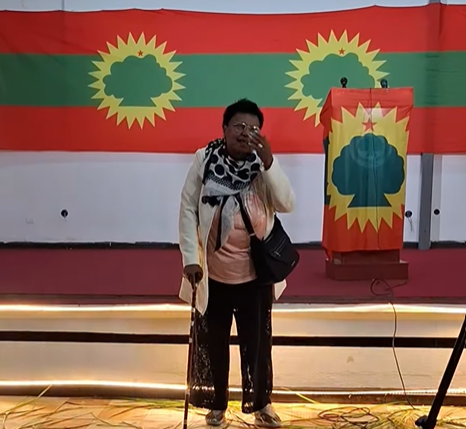
News Feature: The Unbroken Flame – Ilfinash Qannoo Embodies a Lifetime of Struggle and Steadfastness
GULLALLE, OROMIA – In the bustling activity of the Oromo Liberation Front (OLF) headquarters this Amajji 1 celebration, one figure sits with a quiet, palpable gravity. Ilfinash Qannoo, her body bearing the weight of years and the toll of relentless struggle, is a living archive of the Oromo quest for freedom. Too weak to stand, too ill to move independently, she is carried to gatherings, not as an invalid, but as a revered ember of the movement’s enduring fire.
Her presence is a testament, not to frailty, but to an indomitable will. It is the final, physical testament of a life offered completely—uleetti rarraatee—stretched across the altar of the Oromo struggle. Her commitment, born of a profound and unwavering love for the cause, saw her pour her energy into every space she could reach, for as long as she could manage, until her very body could no longer sustain the pace of the fight.
Today, on Oromo World Brotherhood Day (WBO), surrounded by a new generation of activists and leaders at the OLF Gullalle office, Ilfinash Qannoo’s role has transformed from frontline mobilizer to living monument and moral compass. Her journey is a bridge connecting the sacrifices of the past to the responsibilities of the present.
“A Seed That Moves Does Not Rot; The Dead Do Not Rise, So Do Not Fear Them.”
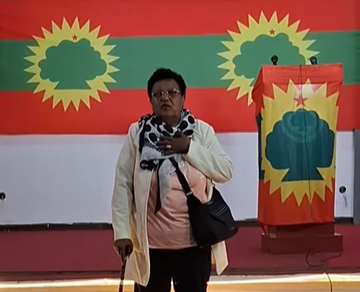
This powerful Oromo proverb, evoked by those who know her story, encapsulates her legacy. Ilfinash Qannoo was never static. She was a “seed” that moved—organizing, advocating, supporting—ensuring the ideas of liberation never stagnated or “rotted” in passivity. Her life’s work was to keep the movement in motion.
Now, her physical stillness speaks volumes. It forces a confrontation with the cost of the struggle and the solemn duty of those who remain. “Do not fear the dead,” the proverb advises, urging the living to act with the courage of those who can no longer stand. In her silent, observant presence, she embodies this charge, a silent reminder that the true threat is not the fallen, but the inaction of those who inherit their dreams.
Her life has been one of radical interdependence—naamaan deeggaramtee—leaning on and being leaned upon by the community she helped build. From providing shelter and intelligence in perilous times to offering counsel and moral support, her strength was always relational, woven into the fabric of the collective struggle.
As officials and well-wishers approach her chair on this day of celebration, they do not offer pity. They offer kabaja—deep respect. They bend to whisper words of gratitude, to seek a silent blessing from her weary eyes. The whispers that surround her are not about illness, but about endurance; not about an ending, but about a transcendent persistence.
“Ulfaadhu, umurii dheeradhu jenna!” – “Be strong, may you have long life!” is the fervent wish expressed for her. It is a wish for the longevity of the spirit she represents: the spirit of self-sacrifice, unconditional love for the cause, and an resilience that refuses to be extinguished.
Ilfinash Qannoo, in her dignified fragility, is more than an individual. She is a symbol. She represents every parent who lost a child, every activist who endured prison, every anonymous supporter who carried the movement forward in shadows. On this Amajji 1, as the Oromo people worldwide celebrate their brotherhood and identity, the image of Ilfinash Qannoo, carried to the heart of the movement’s headquarters, serves as the most profound reminder: that the journey is long, the cost is high, and the flame, once lit by love, must be tended by every generation.
Her silent message echoes in the hall: The seed must keep moving. Do not let it rot. And do not fear—build the future with the courage her life has demanded.
Dhaamsa ABOn Bara 2026: Tokkummaa fi Qabsoo Jabeessuu
Guyyaa Mudde 31, 2025 — Addi Bilisummaa Oromoo (ABO) dhaamsa bara haaraa 2026 isaa dabarsuun, waggaa darbe sirna fi hidhannoo hamaa keessa darbee, qabsoo bilisummaa Oromoo itti fufsiisuuf, tokkummaa fi cimina ummataa waamicha guddaa taasiseera.
Dhaamsi kun, miseensota, hogganoota, deeggartoota ABO fi ummata Oromoo maraaf baga bara haaraa dabarsuun jalqabame, barri haaraas “bara nagaa, milkii, haqaa fi dhugaa” ummataaf akka ta’u abdii guddaa isa keessa qaba.
Hanga ta’us, ABOn hubachiise akka barri 2025 kanatti dhiibbaan siyaasaa fi hidhaa mootummaa Wayyaanee irra gahaa ture, gufuulee hedduu dhaaba fi miseensota isaa irratti geggeeffame. Haala kana keessatti, ABOn akka ibsutti, “sodaa fi bir’annaa tokko malee” hojii siyaasaa geggeessuun itti fufeera. Kunis, waajjira muummee Gullalleen ABO, leenjii haaromsaa miseensotaaf kennuu, fi gumiin sabaa ABO walga’ii dhaabbataa 3ffaa geggeeffachuun hojiilee dandamachaa hojjeteera.
Haala rakkoo kana keessa, dhaabichaan ibsa ulfaataa ummata Oromoo irratti roorroon itti fufuun geggeeffamaa jiru mirkaneessee, akkaataan ajjeechaan maqaan adda addaa, hidhamuun, saamamuun, fi buqqaachisni lammiilee kumootaa Oromiyaa keessatti itti fufuun “ummatni wabii jireenyaa dhabe” jedhee dubbateera.
Dhaabichaan, furmaata kanaaf, “humna Oromoon qabu inni guddaan tokkummaa isaati” jedhee waamicha jabeessaa ummataaf godheera. ABOn waamicha ummatatiin, “sab-boonummaa Oromummaa” jabeessuu, fi “ololoota farrummaa” kan ABO fi qabsoo irratti geggeeffaman irraa of eeguu qofa irratti akka xiyyeeffatan dhaammateera.
Gama siyaasaa biyyattii ilaalchisee, ABOn mormiin isaa sirna PP fi’ila isaa irratti fooyyeessuun, rakkoon siyaasaa fi dinagdee biyyattii “karaa siyaasaa, dinagdee fi hawaasummaan dabalaa jiru” jedhee dubbateera. Kanaaf, ABOn, “qulqullummaan gadi taa’ee qaamota dhimmi ilaalu waliin marii nagaa” geggeeffamuun furmaata argamsiisu irratti yaamicha deebise.
Xumurri dhaamsaa kanaatiin, ABOn ummata Oromoo fi qabsaawoota isaa “irbuu keenya yoom illee haarawaa, abdiin keenyaas guddaa” ta’uu wal irratti abdanna jechuun, qabsoo jabeessuun daandii filannoo biraa hin qabne ta’uu mirkaneessee, barri 2026 bara “ajjeechaa, roorroo fi gidiraan irraa dhaabbatu” akka ta’u abdii guddaa dabarseera.
Dhaamsi ABO kana, fiixaa fi kaka’umsi qabsoo Oromoo itti aanuuf bu’uura cimaa fi waamicha tokkummaa ummataa ta’uun, rakkoo fi dhibee waggaa 2025 keessa mudate irraa ka’uun, qabsoo itti fufuuf yaada gama hundaan qaba.
Remembering Aayyoo Asinaa Abduramaan: A Legacy of Strength

A Pillar of the Struggle Departs: Mourning the Passing of Aayyoo Asinaa Abduramaan, Mother of Jaal Hundee Daraaraa
The Oromo global community is in mourning following the passing of Aayyoo Asinaa Abduramaan, a revered matriarch and steadfast symbol of resilience, who died today after a prolonged illness. Her departure marks not just a personal loss for her family, but a profound moment of collective grief for a nation that saw in her the unbreakable spirit of Oromo motherhood.
Aayyoo Asinaa was more than a mother; she was an expert in life and a mother of freedom fighters. She lived a life defined by immense sacrifice and unwavering dedication to the cause of Oromo liberation. While her own children dedicated their lives to the struggle, she bore the heaviest of burdens, suffering the ultimate loss and enduring hardship without complaint.
She was the mother of Jaal Hundee Daraaraa (MGS_ABO), a freedom fighter of the Oromo Liberation Front (OLF). In the pursuit of Oromia’s freedom, she gave her sons, experiencing both the pain of their loss and the suffering of those who returned bearing the scars of battle. She endured these trials with a heart that remained a source of strength for others, even as her own body and spirit carried wounds that never fully healed.
A Personal Testament to Her Strength
A community member who witnessed her fortitude firsthand shared a poignant memory: “I saw Aayyoo Asinaa for the first time in 2018 when OLF leadership returned to the country. During a public event in Ghindhir town, as leaders addressed the crowd in the South-East region, she saw Jaal Hundee Daraaraa. Remembering her son, lost in the struggle for so many years, she collapsed in tears. It was a heartbreaking scene. She was a consoler of others, a mother of fighters, and a heroine who displayed exceptional grace for Oromia. Her passing leaves a deep ache in our hearts.”
Her life story embodies the quiet, often overlooked, heroism of mothers in liberation movements—those who send their children to the front lines and must find a way to live with the consequences, becoming pillars for their communities while nursing private grief.
A Legacy of Sacrifice and Strength
Aayyoo Asinaa Abduramaan’s legacy is one of profound sacrifice and unyielding dignity. She navigated a path of personal tragedy without allowing bitterness to overshadow her love for her people and their cause. Her life was a testament to the Oromo proverb that true strength is often found in silent endurance.
The community now rallies around her remaining family, offering prayers for strength and unity. “May God grant her mercy,” the statement concluded. “May He provide patience, solace, and resilience to Jaal Hundee and the rest of the family.”
As news of her passing spreads under the hashtag #AayyooAsinaaAbduramaan, social media is filling with tributes, honoring a woman whose name will be remembered alongside the freedom fighters she raised and supported—a true Aayyoo (revered mother) of the nation.
Rest in Power, Aayyoo Asinaa. Your struggle is now your eternal peace.

