By Daandii Oromia
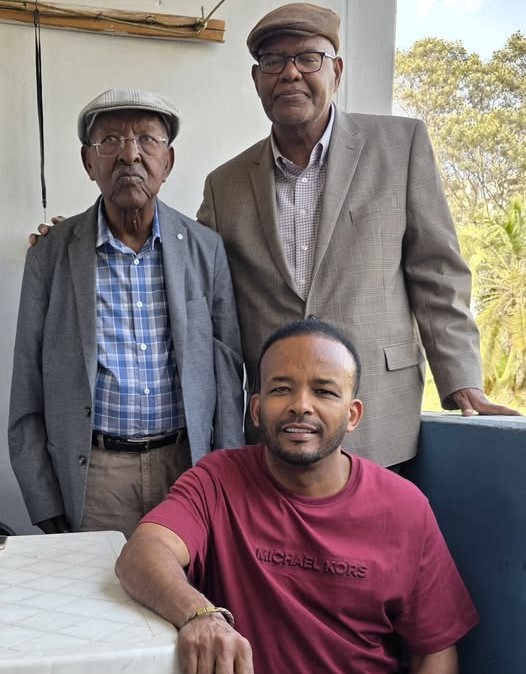
There is a photograph circulating on social media this week. In it, a young man sits at the feet of elders. His head is bowed slightly. The elders regard him with the mixture of suspicion and tenderness that only old men can muster when they look at the young.
The man is Habtamu Lamu. And he has done something remarkable: he has apologised.
“I represent my generation,” he wrote. “I have asked forgiveness from our elders.”
It is a simple act. But in a cultural landscape where elders are too often dismissed as obstacles rather than honoured as anchors, it carries the weight of centuries.
The weight of what was taken
Habtamu’s apology was not generic. It was directed specifically at those who carried the struggle for Oromo liberation through its darkest decades—veterans like the venerable intellectual Leenco Lata and former Oromia President Hasan Ali Waaqayyo.
“Sitting at the feet of elders, I learned many things,” Habtamu wrote. “May God grant them long life.”
One does not need to agree with every political position these men have ever taken to recognise what they represent. They are living archives. They carry within their bones the memory of what was done to the Oromo people, and the memory of what was done by Oromo people in the long march toward dignity.
Leenco Lata, in particular, embodies a certain kind of Oromo intellectual tradition—rigorous, uncompromising, and deeply rooted in the soil of his people’s experience. His writings on Oromo political history are not mere academic exercises; they are acts of preservation, ensuring that a generation born after the struggle understands what came before.
The rejoinder: who owes what to whom?
But no act of public apology goes unanswered in our times. Enter Magaada Boruu, whose response cuts against the grain of Habtamu’s humility.
“We, this generation, have nothing to apologise for,” he wrote. “If anything, we have been imprisoned and tortured ourselves, while they returned to their properties and prospered! Ashqaabbaxuunis hanguma obboo Gingilshaa”
The emojis do not disguise the anger beneath the words. Magaada Boruu speaks for a generation that watched many of the old guard return from exile to reclaim houses and land while young activists filled prisons. He invokes the name of Gingilshaa—the Oromo revolutionary flame—as witness to his claim.
And he is not entirely wrong.
There is a painful asymmetry in the Oromo experience of the past decade. Some elders returned to comfortable retirements. Some young people returned to torture chambers. The revolution devoured its children even as it elevated its patriarchs.
The dialectic of debt
Between Habtamu’s apology and Magaada’s rejection lies the full complexity of Oromo politics today.
Habtamu recognises something true: that generations build upon generations, that no struggle begins in a vacuum, that the young walk paths carved by the old through bush and briar. There is dignity in acknowledging that debt.
Magaada recognises something equally true: that debt can be claimed fraudulently, that suffering is not evenly distributed across generations, that some elders used the young as cannon fodder while securing their own exits. There is justice in demanding accountability.
The danger is that these two truths become mutually exclusive—that the young refuse all honour to the old, or that the old demand all honour from the young without examination of their own compromises.
Sitting at the feet
Habtamu’s photograph captures something worth preserving: a young man choosing to sit rather than to stand, to listen rather than to speak, to honour rather than to dismiss.
In Oromo tradition, the jaarsummaa—the council of elders—is not merely a social institution but a philosophical one. It rests on the understanding that wisdom accumulates slowly, that no single generation possesses all truth, that the young who do not sit at the feet of elders will eventually have no feet to sit at.
But elders, too, have obligations. The feet at which the young sit must be feet that walked toward justice, not away from it. The wisdom imparted must be wisdom tested by experience, not merely authority asserted by age.
The long road
The Oromo struggle has always been a relay race across generations, not a sprint within them. The baton passes from those who fought with the pen (like Leenco Lata), to those who fought with the gun, to those who fight now with keyboards and courage and the willingness to fill prisons.
Each generation stumbles. Each generation falls short. Each generation imagines itself the first to truly understand what is required.
And each generation must decide whether it will honour what came before while building what must come after—or whether it will burn down the past in the name of a future it cannot yet see.
Habtamu has chosen to honour. Magaada has chosen to question.
Perhaps both are necessary. Perhaps the Oromo people need young people who sit at the feet of elders and young people who demand that those elders account for what they did while sitting in comfort.
But in the photograph, the young man sits. The elders look at him. And something passes between them that cannot be captured in Facebook comments or Twitter threads—something older than politics, deeper than grievance, more enduring than any single generation’s anger.
It is simply this: the recognition that we belong to each other across time, that the debt runs both ways, that apology and accountability are not opposites but partners in the long work of becoming a people worthy of our ancestors and our descendants.
May God grant long life to those who carry memory. May God grant courage to those who carry struggle. And may God grant wisdom to all of us who must somehow do both at once.
The views expressed in this commentary are those of the author and do not necessarily reflect the positions of any organisation or institution.

