Exclusive: Prosperity Party Officials Accused of Colluding with Security Forces to Thwart Opposition in Oromia Ahead of June Elections
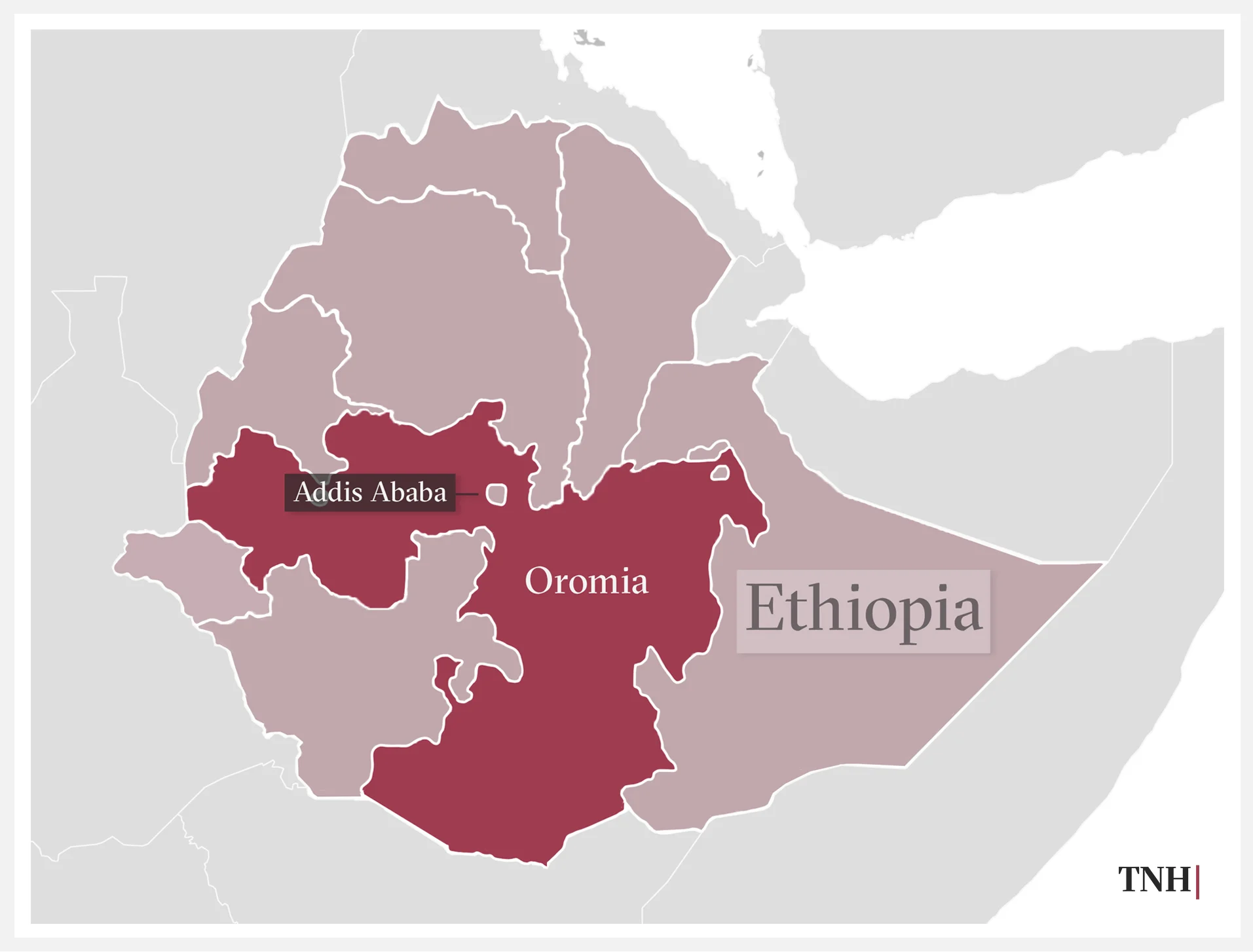
FINFINNE – With less than three months until Ethiopia’s seventh general elections, scheduled for June 1, 2026, the political atmosphere in the Oromia region is becoming increasingly charged. Sources within several zones and districts have revealed to local media that officials from the ruling Prosperity Party (PP) are moving secretly through communities, allegedly instructing party and security bodies to disrupt opposition activities.
According to accounts collected from residents in multiple districts, PP leaders at the zonal and district level are holding undisclosed meetings with security apparatuses. These sources claim that directives have been issued to monitor and crack down on political rivals rather than allowing them to campaign freely.
“People in our districts and zones are not speaking out,” one resident told a local reporter on condition of anonymity. “They told us in secret that directives are being given to party and security offices to work against us. They are using the election as a cover while they try to move through Oromia to stir up trouble and spy on opposition activities.”
The informants specifically identified concerns regarding the Oromo Liberation Front (OLF). Community members expressed that while they have no issue with the OLF contesting elections peacefully, they oppose the idea of the party using the electoral process as a pretext for movement and mobilization across the region under the current circumstances.
“If the OLF wants to compete, let them do so like they do in Addis Ababa, but campaigning inside Oromia is a concern for our party,” a source quoted local PP hardliners as arguing. “But now they are moving through the zones and entering districts. If they are not allowed to compete, it is very worrying. Therefore, we need to follow their movements and take action preemptively.”
These allegations point to a strategy of preemptive disruption, with reports suggesting that regional officials are coordinating with unspecified parties to monitor and counter the opposition’s reach into rural constituencies.
The claims come amid a backdrop of severe political fragmentation and security concerns. Analysts note that the Oromia region, which holds the largest number of parliamentary seats (178 seats in the House of Peoples’ Representatives and 537 in the regional council) , remains a volatile battleground. The Oromo Liberation Army (OLA) insurgency continues in several zones, including East and West Wollega, rendering large areas insecure and complicating logistical preparations for the vote.
Opposition parties have long argued that the playing field is tilted. The Oromo Federalist Congress (OFC) has previously stated that participating in elections while its leaders are imprisoned or under threat would be “politics over the graves of its people” . In a joint statement issued late last year, a coalition of ten opposition parties, including the OLF and OFC, warned that proceeding without “enabling conditions”—such as the release of political prisoners, the reopening of party offices, and guarantees of freedom of movement—would result in a “sham democracy”.
The National Election Board of Ethiopia (NEBE) has cleared over 60 political parties to contest and approved 45 domestic observer groups . However, logistical and security hurdles remain daunting. A recent report by the Ethiopian Human Rights Commission (EHRC) highlighted that freedom of movement is “under siege” in multiple regions, with roadblocks, ambushes, and curfews making it nearly impossible for civilians and candidates to move safely—a prerequisite for any credible election.
“The NEBE must evolve from a mere administrator of rules to a courageous facilitator of political consensus,” wrote Sultan Kassim, an OFC official, in a recent analysis. “An election that is boycotted or only symbolically contested will not resolve Ethiopia’s deep-seated political questions. It will exacerbate them.”.
The residents who spoke out warn that the alleged collusion between party officials and security forces threatens to undermine the will of the Oromo people. “We send a message of brotherhood to everyone holding onto their Oromo identity in the zones and districts,” a resident pleaded. “Do not accept these directives they are giving you. Do not let them drag you into committing a crime against your own people.”
As the June 1 polling date approaches , the credibility of the election hangs in the balance. The combination of active insurgencies, restricted civic space, and deepening distrust between the ruling party and opposition forces suggests that without urgent corrective measures, the 2026 vote may struggle to confer legitimacy or unify the nation.
Commentary: Of Elders, Apologies, and the Weight of Generational Debt
By Daandii Oromia
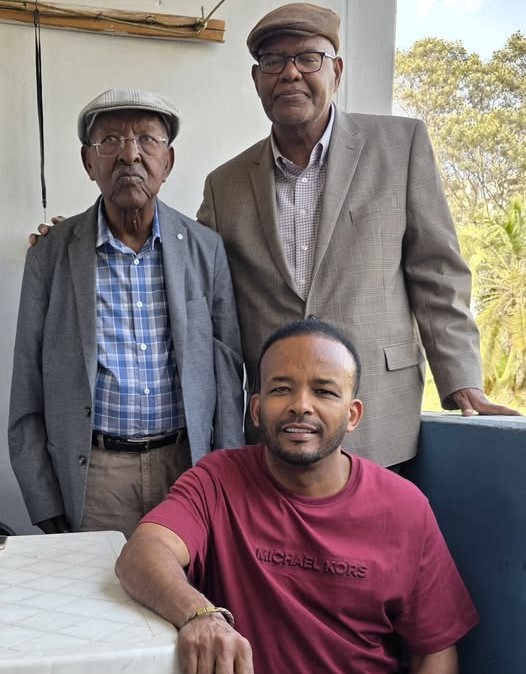
There is a photograph circulating on social media this week. In it, a young man sits at the feet of elders. His head is bowed slightly. The elders regard him with the mixture of suspicion and tenderness that only old men can muster when they look at the young.
The man is Habtamu Lamu. And he has done something remarkable: he has apologised.
“I represent my generation,” he wrote. “I have asked forgiveness from our elders.”
It is a simple act. But in a cultural landscape where elders are too often dismissed as obstacles rather than honoured as anchors, it carries the weight of centuries.
The weight of what was taken
Habtamu’s apology was not generic. It was directed specifically at those who carried the struggle for Oromo liberation through its darkest decades—veterans like the venerable intellectual Leenco Lata and former Oromia President Hasan Ali Waaqayyo.
“Sitting at the feet of elders, I learned many things,” Habtamu wrote. “May God grant them long life.”
One does not need to agree with every political position these men have ever taken to recognise what they represent. They are living archives. They carry within their bones the memory of what was done to the Oromo people, and the memory of what was done by Oromo people in the long march toward dignity.
Leenco Lata, in particular, embodies a certain kind of Oromo intellectual tradition—rigorous, uncompromising, and deeply rooted in the soil of his people’s experience. His writings on Oromo political history are not mere academic exercises; they are acts of preservation, ensuring that a generation born after the struggle understands what came before.
The rejoinder: who owes what to whom?
But no act of public apology goes unanswered in our times. Enter Magaada Boruu, whose response cuts against the grain of Habtamu’s humility.
“We, this generation, have nothing to apologise for,” he wrote. “If anything, we have been imprisoned and tortured ourselves, while they returned to their properties and prospered! Ashqaabbaxuunis hanguma obboo Gingilshaa”
The emojis do not disguise the anger beneath the words. Magaada Boruu speaks for a generation that watched many of the old guard return from exile to reclaim houses and land while young activists filled prisons. He invokes the name of Gingilshaa—the Oromo revolutionary flame—as witness to his claim.
And he is not entirely wrong.
There is a painful asymmetry in the Oromo experience of the past decade. Some elders returned to comfortable retirements. Some young people returned to torture chambers. The revolution devoured its children even as it elevated its patriarchs.
The dialectic of debt
Between Habtamu’s apology and Magaada’s rejection lies the full complexity of Oromo politics today.
Habtamu recognises something true: that generations build upon generations, that no struggle begins in a vacuum, that the young walk paths carved by the old through bush and briar. There is dignity in acknowledging that debt.
Magaada recognises something equally true: that debt can be claimed fraudulently, that suffering is not evenly distributed across generations, that some elders used the young as cannon fodder while securing their own exits. There is justice in demanding accountability.
The danger is that these two truths become mutually exclusive—that the young refuse all honour to the old, or that the old demand all honour from the young without examination of their own compromises.
Sitting at the feet
Habtamu’s photograph captures something worth preserving: a young man choosing to sit rather than to stand, to listen rather than to speak, to honour rather than to dismiss.
In Oromo tradition, the jaarsummaa—the council of elders—is not merely a social institution but a philosophical one. It rests on the understanding that wisdom accumulates slowly, that no single generation possesses all truth, that the young who do not sit at the feet of elders will eventually have no feet to sit at.
But elders, too, have obligations. The feet at which the young sit must be feet that walked toward justice, not away from it. The wisdom imparted must be wisdom tested by experience, not merely authority asserted by age.
The long road
The Oromo struggle has always been a relay race across generations, not a sprint within them. The baton passes from those who fought with the pen (like Leenco Lata), to those who fought with the gun, to those who fight now with keyboards and courage and the willingness to fill prisons.
Each generation stumbles. Each generation falls short. Each generation imagines itself the first to truly understand what is required.
And each generation must decide whether it will honour what came before while building what must come after—or whether it will burn down the past in the name of a future it cannot yet see.
Habtamu has chosen to honour. Magaada has chosen to question.
Perhaps both are necessary. Perhaps the Oromo people need young people who sit at the feet of elders and young people who demand that those elders account for what they did while sitting in comfort.
But in the photograph, the young man sits. The elders look at him. And something passes between them that cannot be captured in Facebook comments or Twitter threads—something older than politics, deeper than grievance, more enduring than any single generation’s anger.
It is simply this: the recognition that we belong to each other across time, that the debt runs both ways, that apology and accountability are not opposites but partners in the long work of becoming a people worthy of our ancestors and our descendants.
May God grant long life to those who carry memory. May God grant courage to those who carry struggle. And may God grant wisdom to all of us who must somehow do both at once.
The views expressed in this commentary are those of the author and do not necessarily reflect the positions of any organisation or institution.
A Scholar Between Two Worlds: Professor Asmerom Legesse Laid to Rest in Asmara
The renowned anthropologist, who bridged Eritrean patriotism with pioneering scholarship on Oromo democracy, was honored at a state funeral after his body was returned from the United States for burial.
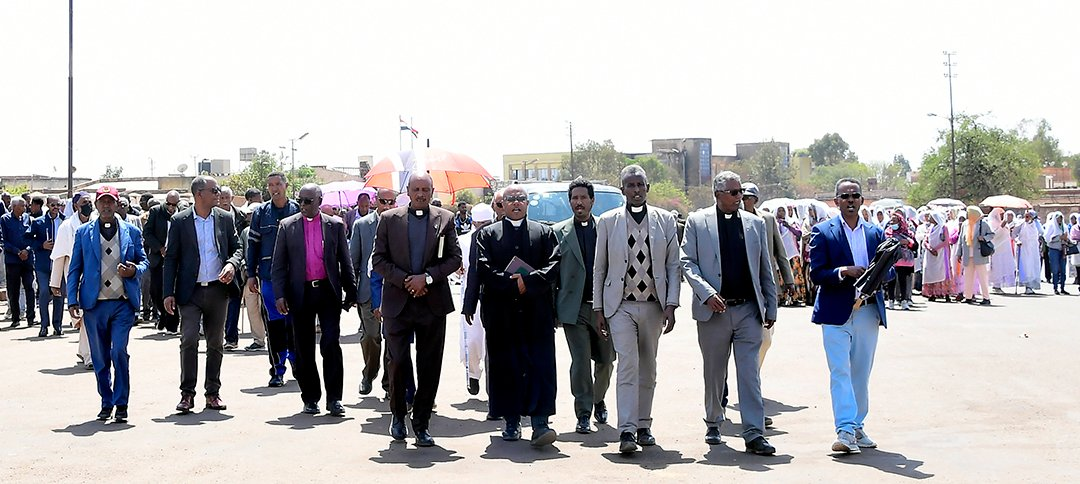
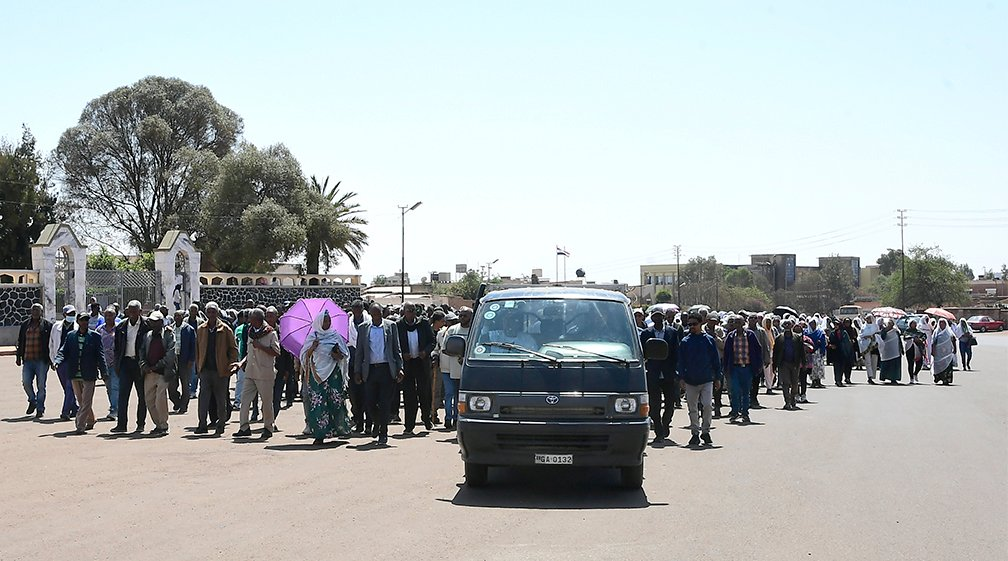
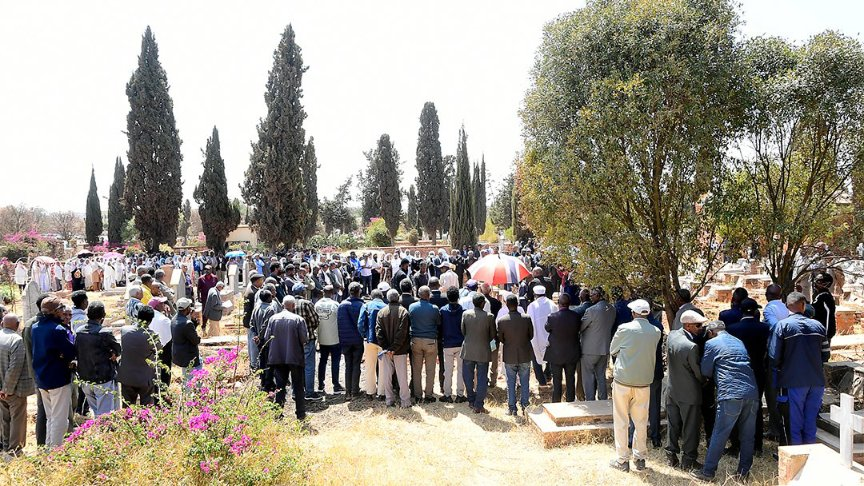
Asmara — A funeral service for Professor Asmerom Legesse was held today at Asmara’s Evangelical Lutheran Church Cemetery, bringing home one of the Horn of Africa’s most distinguished intellectual figures for burial in the land of his birth .
The ceremony was attended by Ministers, senior government and PFDJ officials, religious leaders, and family members, reflecting the high esteem in which Professor Legesse was held by the Eritrean state . His body had been transported from the United States, where he passed away on 31 January at the age of 94 .
The Ministry of Foreign Affairs expressed “deep sorrow” over his passing, conveying condolences to his family and friends in an official statement.
A towering intellectual figure
Professor Asmerom was a prominent and illustrious anthropologist who produced important research during his tenure at some of America’s most prestigious institutions, including Harvard, Boston, Northwestern, and Chicago universities. A Harvard-trained anthropologist, he served as Emeritus Professor of Anthropology at Swarthmore College.
His scholarship spanned more than half a century, during which he conducted extensive field research among the Oromo people of Ethiopia and Kenya, living among Borana and other Oromo communities to understand the intricate workings of the Gadaa system from within .
His seminal 1973 work, Gada: Three Approaches to the Study of African Society, introduced the world to the sophisticated constitutional and democratic principles embedded in the Gadaa system. The book was revolutionary in its methodology and presented Gadaa as a highly developed system of checks and balances, age-set organization, and rotational leadership that had governed Oromo society for centuries.
Nearly three decades later, he published Oromo Democracy: An Indigenous African Political System (2000), which became the most authoritative scholarly work on the subject and was instrumental in UNESCO’s recognition of Gadaa as an Intangible Cultural Heritage of Humanity in 2016.
Two homelands, one legacy
Professor Legesse’s life embodied the complex intertwining of Eritrean and Oromo histories. Born in 1931 in Geza Kenisha, Asmara, he grew up in the same area where the pioneering Oromo scholar Onesimos Nesib had sought refuge and translated the Bible into Afaan Oromoo more than a century earlier. Advocacy for Oromia noted this “physical proximity” as a powerful metaphor, linking the spiritual resilience of those earlier figures with Professor Legesse’s intellectual fortitude in defending Oromo identity.
For the Oromo people, he became known as “Abbaa Gadaa”—a symbolic recognition of his role as a guardian of their threatened heritage. The Oromo Studies Association described him as a “kinsman of the Oromo people” whose work on Oromo customs, history, and culture significantly advanced understanding of political and social systems across Africa.
Defender of Eritrea
Beyond his academic achievements, Professor Legesse served his country and people in various capacities over four decades. From 1984 until independence, he served as Chairman of the U.S. branch of the Eritrean Relief Association, supporting Eritrea’s liberation struggle.
In 1998, he published well-researched documents on atrocities perpetrated by the Ethiopian regime against Eritreans and Ethiopians of Eritrean origin. He also documented and exposed extensive gender-based violence committed by the Ethiopian army during its occupation of various areas, particularly in the Senafe sub-zone during the border war.
In 2015, he played a significant role in countering what Eritrea viewed as attempts to dehumanize the nation through allegations of human rights violations, preparing a critique of the UN Human Rights Commission on Eritrea for a meeting at the House of Lords in the United Kingdom.
A complex political geography
Professor Legesse’s life was not without political complication. In 2017, despite his stature as the world’s leading authority on Gadaa and an invitation to attend a historic Gadaa power transfer ceremony in Borana, the Ethiopian government refused to issue him a visa, citing his Eritrean background . The incident reflected the tragic political tensions that for decades prevented scholarly exchange between the two countries.
Yet his influence on Oromo scholarship remained profound. Ezekiel Gebissa, professor of history and African studies at Kettering University, wrote in a tribute: “For the Oromo people, whose culture Asmarom studied for more than half a century, death is not an ending but a passage from the world of binary reality to the realm of singularity. It is fitting to imagine him joining the ancestors he so often wrote about”.
An enduring legacy
Professor Legesse’s work challenged colonial narratives that had dismissed African governance systems as primitive or lacking in sophistication. The Oromia Culture and Tourism Bureau emphasized that his life’s work preserved the Oromo Gadaa system and documented its practices for future generations, serving as a bridge for knowledge and scholarship.
The Oromo Liberation Front issued a statement describing his passing as a significant loss to the Oromo community. “His research highlighted Gadaa’s principles of equality, leadership rotation, and social cohesion, positioning it as a model of African democracy,” the statement read.
At his funeral in Asmara, the gathering of state officials, religious leaders, and family members honored a man who had walked many paths—from the shearing sheds of his youth to the hallowed halls of Harvard, from the remote airstrips of Farrer to the Gadaa assemblies of Borana. His final manuscript, Gada: Democratic Institutions of the Borana Oromo, is expected to be published posthumously.
“His work did not merely preserve the past,” wrote OROMIA TODAY in a tribute. “It equipped future generations with evidence and language to assert historical truth”.