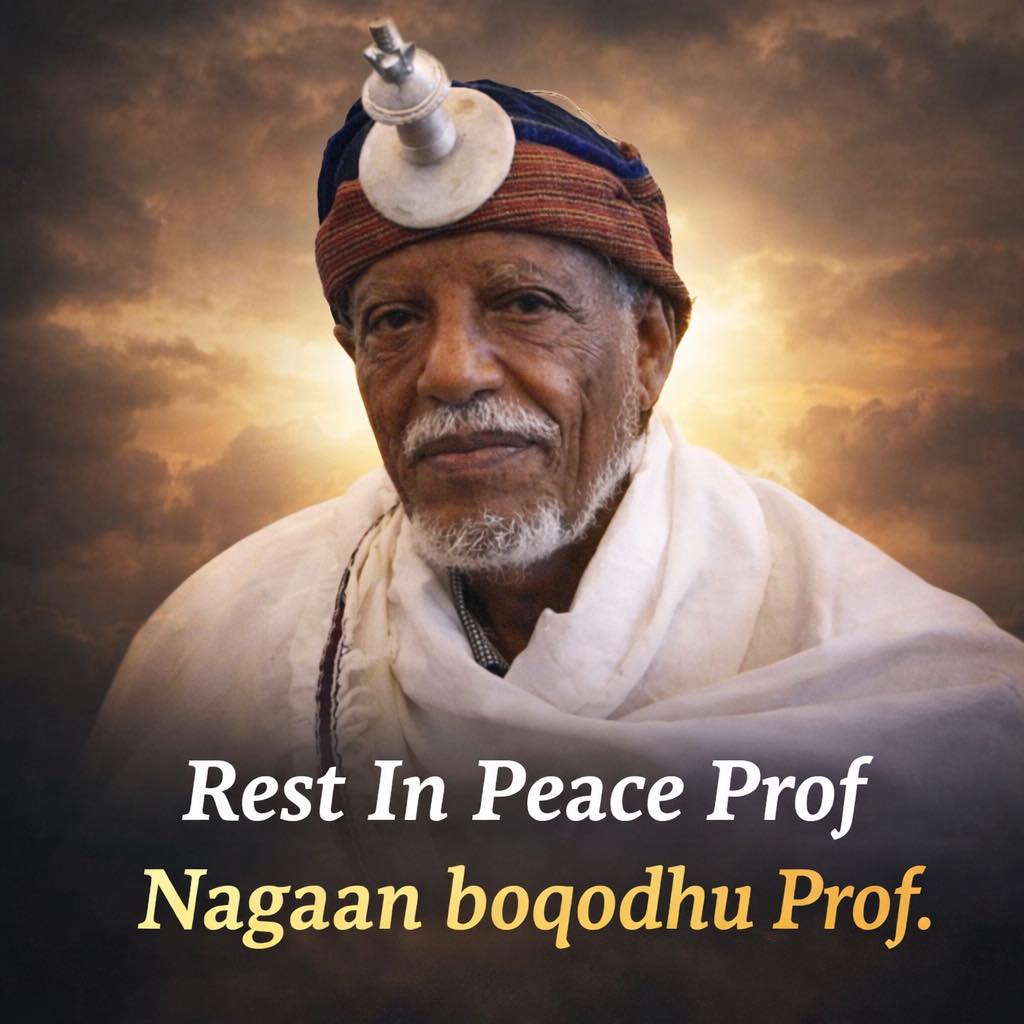
We are deeply saddened by the passing of Abbaa Gadaa Professor Asmerom Legesse, a towering African intellectual whose scholarship stands among the most consequential contributions to Oromo history and African political thought.
Abbaa Gadaa Professor Asmerom Legesse, an Eritrean social anthropologist trained at Harvard University and later a distinguished professor at institutions including Boston University, Northwestern University, Swarthmore College, and Yale University, devoted rare rigor and integrity to African knowledge systems. Yet his true stature was not defined by titles, but by the seriousness with which he treated the Oromo Gadaa system.
At a time when African societies were routinely dismissed as lacking political sophistication, he refused to reduce Gadaa to “custom” or folklore. Through disciplined research and cultural immersion, he framed Gadaa as an indigenous constitutional order—built on rotating generational leadership, codified law (seera), institutional checks and balances, accountability, and collective sovereignty.
His landmark work, Gadaa: Three Approaches to the Study of African Society (1973), introduced the world to the depth and coherence of Oromo political organization. Decades later, Oromo Democracy: An Indigenous African Political System (2000) further clarified Gadaa as an egalitarian democratic system whose institutional logic long predates modern Western models. These works remain core references for understanding Oromo governance and for challenging enduring stereotypes about African political thought.
Abbaa Gadaa Professor Asmerom Legesse understood what many still refuse to acknowledge: Oromo history is not marginal, not invented, and not secondary to anyone else’s narrative. It is a complete intellectual tradition—deserving serious documentation, protection, and transmission. By recording Gadaa with scholarly precision, he did more than study Oromo society; he defended it against erasure and misrepresentation.
For this reason, Oromo communities came to hold him in special esteem, symbolically recognizing him as an “Abbaa Gadaa”—a guardian of truth and a custodian of a threatened heritage. Beyond Oromo studies, he wrote on Eritrean refugees, and wider questions of displacement, power, and justice in the Horn of Africa, embodying the responsibilities of a public intellectual.
We at OROMEDIA express our heartfelt condolences to his family, colleagues, students, and all communities touched by his life and work. We also offer our deep gratitude for the intellectual ground he helped secure for generations of Oromo scholars and citizens. His scholarship did not merely preserve the past; it equipped future generations with evidence and language to assert historical truth.
Rest in power, Abbaa Gadaa Professor Asmerom Legesse. Your work lives on, wherever Gadaa is studied, defended, and lived as a testament to indigenous Oromo democracy and African intellectual greatness.

