The ‘Without Me’ Mentality and Ethiopia’s Crisis

Examining the Broader Causes of Instability in Ethiopia
===============================
The core argument, as articulated by Sena Jimjimo, founder of OLLAA, is that a lack of internal consensus and a toxic culture of “without me” thinking within Oromo political factions pose a significant danger to Ethiopia.
She contends that this mindset has led to a situation where:
Truth is Sacrificed for Unity: Oromo fighters avoid difficult truths with each other to maintain a superficial unity.
Individual Ambition Over Collective Good: The belief that liberation can only be achieved through a specific leader or group (“without me”) has been destructive.
Resulting Instability: This failure to build a unified, truth-based movement has ultimately made Ethiopia unsafe.
Counter-Response
While Sena Jimjimo raises valid concerns about the dangers of political fragmentation and individual ambition, her analysis risks misdiagnosing the core problem by focusing on a single group.
A more comprehensive perspective would argue that Ethiopia’s instability stems from a systemic failure to build a genuinely inclusive, multi-ethnic state, not from the internal dynamics of one community.
Here is a counter-response:
Subject: Re: Examining the Broader Causes of Instability in Ethiopia
The challenges facing Ethiopia are complex and cannot be attributed to the internal politics of any single group. While introspection within all political movements is necessary, framing the “Oromo” or “Oromo fighters” as the primary danger is a reductive and counterproductive narrative.
The true source of Ethiopia’s instability is the decades-long, systemic failure to establish a political framework where all ethnic groups feel they have a secure and equitable stake in the nation’s future. The “without me” mentality is not an Oromo-specific issue; it is a symptom of a zero-sum political culture that has been fostered by successive central governments. When communities are historically marginalized and their demands for self-determination are met with violence or empty promises, it inevitably breeds factionalism and a desperate struggle for agency.
Furthermore, the call for “unity” must be critically examined. Too often, calls for national unity have been a pretext for suppressing legitimate grievances and enforcing assimilation. The courage to tell “the truth” that Ms. Jimjimo calls for must apply equally to all sides—including acknowledging the historical injustices that have fueled the very divisions she laments.
Therefore, the path to a safe and stable Ethiopia does not lie in singling out one group, but in addressing the foundational issues: building robust institutions that guarantee justice and equality for all, fostering a culture of genuine political compromise, and creating a shared national identity that respects and celebrates Ethiopia’s rich diversity. The solution requires a collective responsibility from all of Ethiopia’s national political forces, not a critique of one.
President Afwerki’s Disappointing Remarks on Oromummaa

By Zelalem Negassa
The internet is abuzz following President Isaias Afwerki’s recent speech commemorating the 34th anniversary of Eritrea’s independence. While his address touched on a range of global and regional issues, one particular remark struck a deep and troubling chord for me: his dismissal of Oromummaa as part of an externally driven destabilization agenda.
Such a statement reveals either a profound ignorance of Oromo history and identity (which I doubt on his part) or a calculated attempt to delegitimize one of the most significant indigenous movements in the Horn of Africa. As Oromo nationalists, we must collectively and unequivocally reject this distortion and reaffirm both the authenticity and legitimacy of Oromummaa as the rightful expression of our people’s journey toward justice, dignity, and self-determination. Oromo community, scholarly, professional, and civic organizations should raise their voices and ensure that the Eritrean people understand our deep disappointment with their leader’s betrayal. Moreover, President Afwerki’s deliberate or careless conflation of Oromummaa with the ideology of the Prosperity Party (PP) must be corrected without delay. Oromummaa is not a state-sponsored doctrine like MEDEMER. It is a people-rooted identity forged through struggle, not power. Misrepresenting it undermines not only Oromo aspirations but also regional understanding and trust.
President Afwerki’s claim that Oromummaa “does not represent the Oromo people” is not only factually incorrect, it is deeply offensive. More importantly, who gave him the authority to speak on behalf of the Oromo people? This is the same man who hosted the Oromo Liberation Front (OLF) in Eritrea for years, not out of solidarity, but seemingly as a strategic pawn, keeping the movement inactive while waiting for an opportune moment to bargain. That moment came in 2018, when he handed over OLF leaders to the Ethiopian government in a move that many rightly view as a betrayal. Oromummaa is not an invention of foreign powers. It is a homegrown cultural and political consciousness grounded in the Oromo people’s values, language, Gadaa system, and collective memory. It emerged organically as a response to a century of marginalization under successive regimes, and it now serves as a unifying force among Oromos across religion, region, and generation.
His comments have already sparked widespread responses from Oromo voices, including outlets like Oromia Dispatch and scholars such as Dr. Mebratu Kelecha, who have rightfully condemned the characterization and challenged other problematic claims in his speech. These responses reflect a growing awareness within the Oromo public of the importance of defending our narrative and confronting external efforts to distort it.
To President Afwerki, I would offer this reminder: once, Eritreans too were told they were not a real people, that their language was an invention. That their struggle for independence was orchestrated by foreign hands (Ya Arab kitrenyoch). They were mocked, dismissed, and delegitimized. History proved those voices wrong.
It will do so again, this time, with respect to Oromummaa. No amount of propaganda, denial, or geopolitical spin can silence a people who have found their voice, reclaimed their history, and are determined to shape their future.
Ethiopia’s Crisis: Human Rights Violations in Oromia
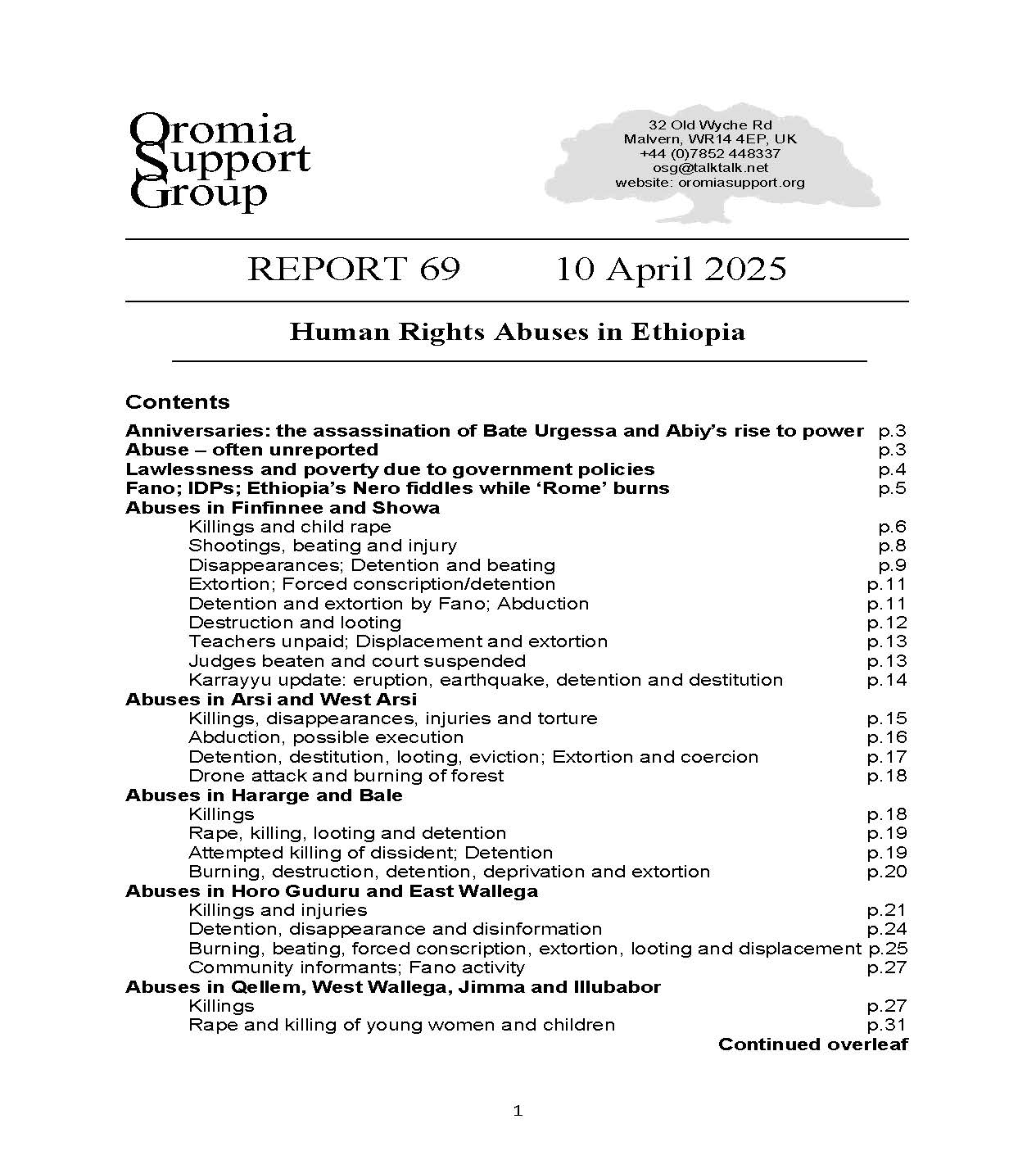
The 10 April report from the Oromia Support Group is shocking. Among unprecedented levels of human rights violations, it documents increasing persecution of Oromo youth, the Qeerroo generation which propelled Abiy Ahmed to power, with page after page of documented killings.
Prime Minister Abiy Ahmed’s security forces – the ENDF, regional police forces and poorly trained militia – are taking punitive measures against Oromo civilians, killing young and old, destroying homes and looting livestock to deter the population from supporting the Oromo Liberation Army.
Report 69 includes information about areas which usually receive little attention such as the zones of Guji and West Guji. But nowhere in Oromia Region is safe or secure.
Ordinary people in urban and rural settings are suffering unsustainable levels of taxation and abuse. Farmers are made to sell their grain to the government at prices below market value. Villagers are forced at gunpoint to provide their children as conscripts, to pay taxes and fees for construction, and to arm and sustain the federal army and militia at district and kebele levels. Undisciplined militia live off the populace, demanding money and goods in addition to spurious fees for party membership, uniforms, ammunition and ‘health insurance.’
Lawlessness and a dog-eat-dog mentality pervades rural Ethiopia. Villagers and townsfolk in areas adjacent to Amhara Region, especially Horo Guduru and East Wallega, but also zones of Showa and within the Oromia Special Zone in Amhara Region, are also subjected to group killings and looting by Fano militants, originally from Amhara Region but now operating from bases in Oromia.
The ideology of Fano ‘to make Amhara great again’ denies history and portrays the Prosperity Party regime as an ‘Oromo government’ to justify its acts of ethnic cleansing in Oromia Region. Meanwhile, the populace in Amhara Region suffers attacks and reprisal killings from ENDF and Fano forces in the zero-sum game of absolute domination which has bedevilled the Ethiopian empire since its formation.
The current instability and mayhem is unsustainable. Ethiopia’s survival as a state depends on a negotiated peace between the government, Amhara and Oromo forces.
Dr Trevor Trueman, Chair, Oromia Support Group, 10 April 2025.

