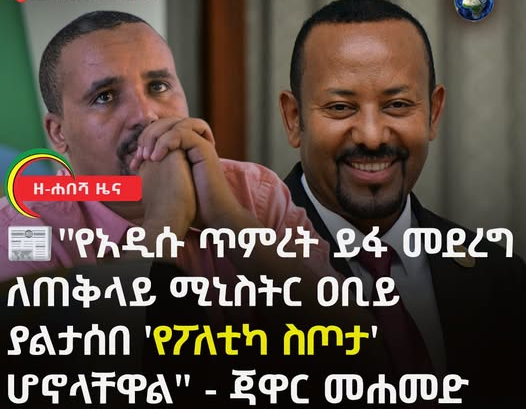
(Zehabesha, ADDIS ABABA) — Political analyst and activist Jawar Mohammed has released a comprehensive strategic and political analysis of the newly formed “Survival Alliance” (Alliance for Survival), a coalition established against the Ethiopian federal government that reportedly includes the Tigray People’s Liberation Front (TPLF), the Eritrean government, the Oromo Liberation Army (OLA/Shane), and Fano.
The analysis, which has circulated widely among political observers, paints a picture of a coalition fraught with internal tensions, where the stakes vary dramatically between members and where recent military and political decisions will determine its ultimate fate.
A Coalition of Unequal Stakes
According to Jawar’s analysis, the Survival Alliance represents an existential question for some of its members—particularly the TPLF and Eritrea—for whom the coalition is a matter of life and death, survival or annihilation. If the alliance succeeds, it could preserve their political standing; if it fails, it could accelerate their destruction.
For Fano and the OLA/Shane, however, the calculation is different. Jawar argues that for these groups, the alliance is a strategic matter rather than an existential threat. They do not face the same level of risk if the coalition collapses, giving them greater flexibility in their commitments.
The Ball is in Tigray’s Court
The analysis suggests that the immediate burden of action falls on the TPLF. Having exerted significant pressure for the alliance to be publicly announced, the TPLF now faces a critical test: if it does not launch a large-scale and decisive offensive soon, it will struggle to bring other alliance members into active operation.
The Eritrean government, meanwhile, is said to be pursuing a “wait and see” strategy, seeking to keep the war as far from its borders as possible. According to Jawar’s analysis, Eritrea will only enter direct combat if the TPLF either wins decisively or is defeated and pushed back to Eritrean territory.
The Role of External Actors
A crucial dimension of the conflict, according to the analysis, is the role of external supporters. How much force Egypt is willing to commit to break the air superiority enjoyed by Prime Minister Abiy Ahmed and the United Arab Emirates (UAE), as well as how much support the UAE and Saudi Arabia provide to whom, will significantly determine the war’s trajectory.
Additionally, the analysis suggests that if Eritrea enters the war directly, Prime Minister Abiy may seize the opportunity to link his “Red Sea and Assab” agenda to existential and security concerns, potentially making it a central focus of the conflict.
The Great Paradox
The most significant and controversial conclusion of Jawar’s analysis concerns what he describes as the “stunning contradiction” created by the alliance’s public announcement.
On one hand, the formation of the alliance strengthens the TPLF’s negotiating position with the government, allowing it to demonstrate that it has “another option” at the negotiating table.
On the other hand, the same public announcement has handed Prime Minister Abiy’s administration what Jawar describes as a “political gift from the sky.” The government can now reinforce its long-standing narrative of a “security threat emanating from the north,” using it as a powerful tool to mobilize public opinion—particularly among the Oromo people—and consolidate support around its leadership.
The True Measure of Success
Jawar’s analysis concludes that the success of this alliance will not be measured by its public statements, but by the internal cohesion and coordination that forces with vastly different territorial ambitions and histories—such as Fano and the TPLF—can demonstrate on the battlefield, and how they withstand the government’s counter-offensive capacity.
The coming weeks and months will reveal whether the Survival Alliance can translate its public declaration into coordinated military action, or whether its internal contradictions will prove insurmountable.
About the Analyst:
Jawar Mohammed is a prominent Oromo political analyst, activist, and former media owner known for his commentary on Ethiopian politics, federalism, and Oromo nationalism. He has been a controversial figure in Ethiopian political discourse, advocating for Oromo rights and systemic reform.

