Unfinished Liberation: The Oromo People at a Crossroads of Struggle and Resurgence
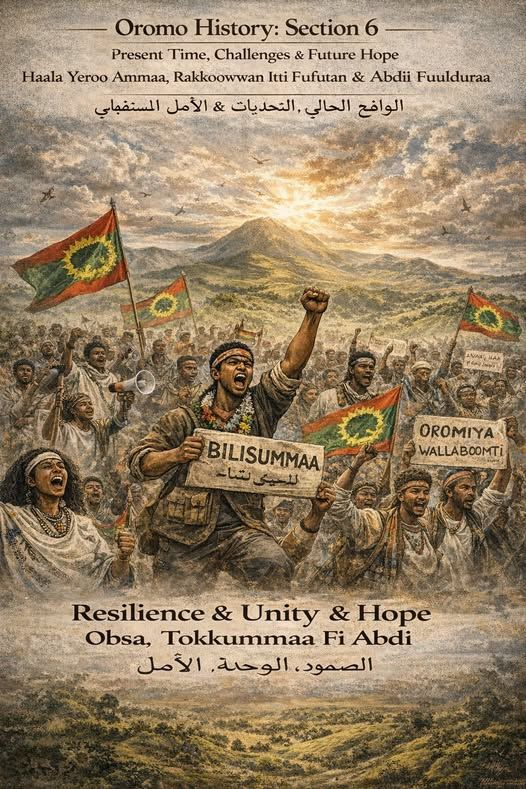
A PRESENT OF PROTEST, A FUTURE OF POSSIBILITY**
The story of the Oromo people, the largest ethnic group in Ethiopia, has long been narrated as a history of resistance against centuries of marginalization. But history is not a closed book. As the community moves through the 21st century, its narrative is one of a profound and tense present—a reality where deep-rooted political challenges coexist with an unprecedented cultural revival, and where the struggle for self-determination is being redefined by a new generation.
This sixth chapter of Oromo history is not about the past; it is a living document, written daily in protests, in songs, in displacement camps, and in the global halls of advocacy.
The Persistent Political Paradox
Demography has not translated into democracy for the Oromo. Constituting an estimated 35-40% of Ethiopia’s population, they remain in a paradoxical position: a numerical majority without commensurate political power. Critical decisions concerning land, security, and resources are still centralized, leaving many Oromos feeling politically sidelined in their own homeland. This structural marginalization is the bedrock of ongoing discontent and the primary catalyst for the powerful protest movements that have shaken the nation over the past decade.
A Landscape of Insecurity and Displacement
The political tension has a human cost. In recent years, several Oromia regions have been plagued by instability. Reports from human rights organizations and media detail cycles of violence involving armed groups and state security forces, leading to civilian casualties, widespread internal displacement, and persistent allegations of rights abuses. Families have been uprooted, farms abandoned, and a pervasive climate of fear has disrupted the social fabric, casting a long shadow over daily life and economic stability.
The Unbreakable Spirit: Cultural Renaissance
Against this challenging backdrop, a powerful counter-narrative flourishes: a cultural renaissance. The Oromo language, *Afaan Oromo*, once suppressed, is now a working language of the Oromia region and is thriving in media, education, and digital spaces. Oromo music, art, and literature are experiencing a golden age, with artists like the late Hachalu Hundessa becoming national icons of resistance and identity. This cultural reawakening is not a retreat but a reclamation—a tool of resilience and a defiant affirmation of existence. Young people, in particular, wear their Oromo identity with a pride that is both personal and political.
The New Architects: Qeerroo and Qarree
The engines of this new chapter are the youth (*Qeerroo*) and women (*Qarree*). The *Qeerroo* movement, a leaderless network of young Oromos, demonstrated its formidable power in the 2014-2018 protests that helped usher in a political transition. Simultaneously, *Qarree*—Oromo women—are moving powerfully from the background to the forefront, organizing, advocating, and demanding a seat at every table, challenging both external oppression and internal patriarchy. Their grassroots activism represents the most dynamic force in contemporary Oromo society.
A Global Struggle with a Peaceful Heart
Oromo activism has consistently emphasized peaceful resistance, even in the face of violence. This principled stance, coupled with the strategic work of a large and mobilized global diaspora, has successfully internationalized the Oromo question. From parliaments in Washington and Brussels to universities worldwide, the call for Oromo rights and self-determination is now part of the global discourse on human rights and federalism in Ethiopia.
Hope Anchored in Unity and Knowledge
The path forward is fraught but illuminated by a clear vision. Community leaders and intellectuals stress that the future hinges on internal unity, a deep understanding of their own history, and an unwavering commitment to peaceful struggle and dialogue. The goal is not just political change but the building of a society where Oromo identity is the foundation for dignity, justice, and shared prosperity.
Conclusion: A Story Still Being Told
This Oromo history confirms that their story is still unfolding. It is a present-tense narrative of simultaneous pain and power, of loss and limitless cultural vitality. The struggle for a truly equitable place within Ethiopia continues, but it is now carried by a generation armed with history, mobilized by technology, and inspired by an unbroken spirit. The Oromo history, as it is written today, remains—above all—a enduring story of survival, resistance, and an undimmed hope for a future of their own making.
 Oromedia