Ilfinash Qannoo: A Symbol of Oromo Resilience
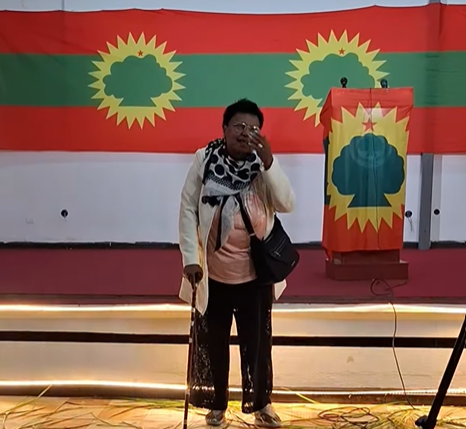
News Feature: The Unbroken Flame – Ilfinash Qannoo Embodies a Lifetime of Struggle and Steadfastness
GULLALLE, OROMIA – In the bustling activity of the Oromo Liberation Front (OLF) headquarters this Amajji 1 celebration, one figure sits with a quiet, palpable gravity. Ilfinash Qannoo, her body bearing the weight of years and the toll of relentless struggle, is a living archive of the Oromo quest for freedom. Too weak to stand, too ill to move independently, she is carried to gatherings, not as an invalid, but as a revered ember of the movement’s enduring fire.
Her presence is a testament, not to frailty, but to an indomitable will. It is the final, physical testament of a life offered completely—uleetti rarraatee—stretched across the altar of the Oromo struggle. Her commitment, born of a profound and unwavering love for the cause, saw her pour her energy into every space she could reach, for as long as she could manage, until her very body could no longer sustain the pace of the fight.
Today, on Oromo World Brotherhood Day (WBO), surrounded by a new generation of activists and leaders at the OLF Gullalle office, Ilfinash Qannoo’s role has transformed from frontline mobilizer to living monument and moral compass. Her journey is a bridge connecting the sacrifices of the past to the responsibilities of the present.
“A Seed That Moves Does Not Rot; The Dead Do Not Rise, So Do Not Fear Them.”
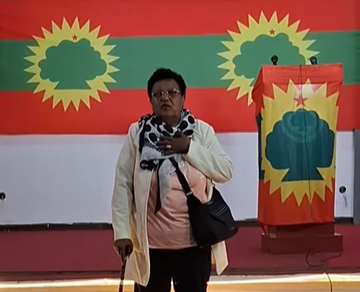
This powerful Oromo proverb, evoked by those who know her story, encapsulates her legacy. Ilfinash Qannoo was never static. She was a “seed” that moved—organizing, advocating, supporting—ensuring the ideas of liberation never stagnated or “rotted” in passivity. Her life’s work was to keep the movement in motion.
Now, her physical stillness speaks volumes. It forces a confrontation with the cost of the struggle and the solemn duty of those who remain. “Do not fear the dead,” the proverb advises, urging the living to act with the courage of those who can no longer stand. In her silent, observant presence, she embodies this charge, a silent reminder that the true threat is not the fallen, but the inaction of those who inherit their dreams.
Her life has been one of radical interdependence—naamaan deeggaramtee—leaning on and being leaned upon by the community she helped build. From providing shelter and intelligence in perilous times to offering counsel and moral support, her strength was always relational, woven into the fabric of the collective struggle.
As officials and well-wishers approach her chair on this day of celebration, they do not offer pity. They offer kabaja—deep respect. They bend to whisper words of gratitude, to seek a silent blessing from her weary eyes. The whispers that surround her are not about illness, but about endurance; not about an ending, but about a transcendent persistence.
“Ulfaadhu, umurii dheeradhu jenna!” – “Be strong, may you have long life!” is the fervent wish expressed for her. It is a wish for the longevity of the spirit she represents: the spirit of self-sacrifice, unconditional love for the cause, and an resilience that refuses to be extinguished.
Ilfinash Qannoo, in her dignified fragility, is more than an individual. She is a symbol. She represents every parent who lost a child, every activist who endured prison, every anonymous supporter who carried the movement forward in shadows. On this Amajji 1, as the Oromo people worldwide celebrate their brotherhood and identity, the image of Ilfinash Qannoo, carried to the heart of the movement’s headquarters, serves as the most profound reminder: that the journey is long, the cost is high, and the flame, once lit by love, must be tended by every generation.
Her silent message echoes in the hall: The seed must keep moving. Do not let it rot. And do not fear—build the future with the courage her life has demanded.
 Oromedia