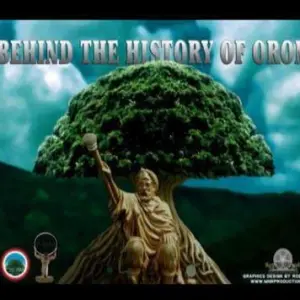
(By Saamraawiit Girmaa)
Oromia is renowned for its vast and stunning natural beauty. It is a land rich with diverse wildlife, plants, mountains, rivers, lakes, and other natural wonders. A significant portion of Ethiopia’s forests are located within this region, a fact confirmed by scientific studies.
Among its many tree species—such as the Laaftoo, Birbirsa, and Harbuu—one stands apart in its cultural significance: the Odaa tree. This article, inspired by the book ‘Sirna Gadaa, Siyaasa Oromoo Tuulamaa’ (Volume 1), explores the deep respect and love the Oromo people hold for the Odaa and its central role in their history.
The Tree and Its Symbolism
The Odaa is a sprawling, evergreen tree with dense, umbrella-like foliage. It does not grow excessively tall, but thrives in areas with high groundwater levels. Its expansive, long-lived canopy provides immense shade, offering a vital refuge for people and livestock. This very shade is the foundation of its sacred status.
In Oromo history, since the inception of the Gadaa system, the Odaa’s shade has been the designated space for conducting matters of faith, politics, and society. The Odaa is considered a lofty, blessed tree and a source of peace. It serves as the place where Gadaa members are promoted, celebrations are held, and political discourse takes place. It is also the site for the Muuda pilgrimage and the assembly hall for Gadaa fathers.
Furthermore, the Odaa is seen as a source of peace and a symbol of Oromo identity and unity. Beyond its political and religious functions, it is a deeply respected natural entity. As a religious symbol, the Odaa connects the present generation to their ancestors; when rituals are performed under its branches, the legacy of past generations is vividly remembered.
Historical and Spiritual Origins
While a complete historical record of why and when the Odaa became a central political and religious symbol is complex, oral traditions provide powerful insights. These traditions, passed down through generations, indicate that the Oromo prayed to Waaqa (God) under the Odaa long before the arrival of Islam and Christianity.
In the Waaqeffannaa religion, Waaqa communicates with humanity through Ayyaana (spiritual forces). Natural sites like lakes, mountains, and great trees are seen as abodes of these Ayyaana, making them sacred places of worship, prayer, and ritual sacrifice. Evidence suggests the Odaa was a spiritual center even before the political rise of the Gadaa system, with parallels found in other Cushitic cultures.
The Foundational Myths
Oromo oral tradition intimately links the origins of Gadaa with the Odaa tree. One foundational myth states:
“In the beginning, the Sky (Waaqa) and the Earth were close. One day, a strong wind caused the livestock of Waaqa to stampede, creating a rift. From that day, Waaqa distanced himself from humanity and creation. This marked the beginning of a long period of spiritual separation.
However, amidst this, the Odaa tree and the Walaabuu spring alone remained steadfast. The Odaa provided shade for livestock and people, while Walaabuu was a source of water. It was under this Odaa that people began to gather to pray for reconciliation and rain.”
This narrative establishes the Odaa as the original site for prayer and the beginning of a covenant with God. The myth continues that after prolonged prayer, Waaqa sent his first-born son, the Qaalluu (or Prophet), who appeared under the Odaa at the Walaabuu spring to teach divine law (seera) and moral order (safuu).
Another myth tells of a healer from the Walaabuu area who, while searching for a lost cow, rested under an Odaa tree. A mist descended from Waaqa, enveloping the tree and its surroundings. The healer was then chosen to become Waaqa’s messenger (Abbaa Raagaa), teaching divine law under the Odaa. From that day, the Odaa was declared a sacred place where God’s voice is heard.
These stories highlight two crucial ideas: first, that religious thought predates the Gadaa system, and second, that Gadaa law is derived from Waaqa’s law. The Qaalluu ensures these laws are upheld and justice is maintained in society. Thus, the Odaa is revered as the place where God solidified his relationship with humanity.
Dating a Ancient Institution
Many Cushitic peoples share similar governance systems. While scholars have noted the historical and religious connections between Cushitic cultures and the Gadaa system, there has been a lack of consensus on its origin date.
Some scholars, like Ehert, suggest the religious ideas behind the system began around 7000 BC. The formation of the social institution itself is often estimated between 3500 and 1000 BC.
However, recent research by Dr. Gammachuu Magarsa, using Oromo oral history and Gadaa chronology, provides a more precise calculation. His study indicates that this socio-political institution began in 3060 BC. This timeline, based on the Gadaa cycle of 8 years per generation, lends support to the theory that Gadaa was established as a formal institution around 2000 BC.
Conclusion
In summary, while the Odaa tree holds an undeniable and profound connection to the history and faith of the Oromo people, the exact origins of its role as a spiritual and political symbol require further scholarly research.
Therefore, we urge Oromo scholars and relevant institutions to dedicate more research to this subject. We also invite you, our readers, to share any historical narratives or oral traditions about the Odaa from your own localities through our platform, so that we may include them in this ongoing exploration of our heritage.
 Oromedia