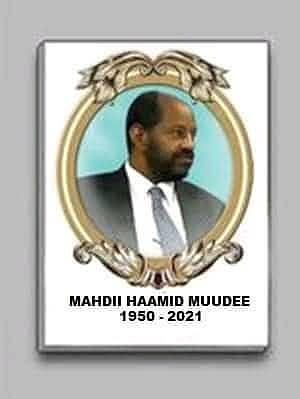
Feature Commentary: The Unbreakable Word – The Life and Legacy of Mahdi Hamid Mudde
In the struggle for the soul of a people, language is not merely a tool for communication; it is the very soil from which identity, memory, and sovereignty grow. To erase a language is to prepare the ground for a people’s dissolution. This understanding has driven the century-long project of cultural assimilation targeting the Oromo people, a project met not with submission, but with the defiant scholarship of guardians like Mahdi Hamid Mudde (Abbaa Bariisaa).
Mahdi’s story, which began in Ciroo, eastern Oromia, in 1950, is a testament to a truth his persecutors understood all too well: “If the language lives, the people live. If it is silenced, like a foundation pillaged from a house, the people too will be erased.” From his first day of school, Mahdi encountered this erasure as policy. A child who knew only Afaan Oromoo, he was thrust into a system where Amharic was the sole medium of instruction. He was marked not as a student, but as duudaa—mute, ignorant—subject to ridicule from teachers and peers alike for the “crime” of speaking his mother tongue.
Yet, in that cruelty, a revolutionary consciousness was forged. Mahdi perceived the humiliation not as a personal failing, but as the sharp end of a political spear aimed at the heart of Oromumma. He made a covenant with himself: the scorn he endured would only bind him more tightly to the language and culture they sought to strip from him. This early resolve charted the course of his life.
Excelling academically, he became a teacher, but his true classroom was the wider Oromo society. He traversed the countryside, learning from elders and hayyus, documenting oral histories, proverbs, and the intricate social fabric. He immersed himself in the study of orthography, analyzing the Arabic, Ge’ez, and Latin scripts to determine the most viable path for written Afaan Oromoo. His quest led him to the renowned Oromo language scholar, Sheikh Bakri Sapalo, further solidifying his mission.
His scholarly dedication collided with national politics in 1974 with the rise of the Derg regime. The regime’s “Zemacha” (Development Through Cooperation Campaign) program, while mobilizing students for rural development, had a sinister subtext: to accelerate Amharization. Mahdi, insightfully recognizing this, submitted a formal linguistic proposal. He presented two scripts: a functional Latin-based orthography and a deliberately cumbersome Ge’ez-based one, aimed at proving the latter’s impracticality. The Derg’s ideologues, wedded to a myth of Semitic supremacy, chose Ge’ez. In this apparent defeat, however, Mahdi secured a monumental victory: he forced the state to officially engage with the question of writing Afaan Oromoo. His efforts directly led to the 1975 publication of the first Oromo-language primer, Bariisaa, using the Ge’ez script—a flawed but historic crack in the dam of linguistic prohibition.
Facing intensifying persecution for his activism, Mahdi fled into exile in 1977, eventually settling in the United States. Yet, exile did not diminish his labor; it globalized it. In 1995, after years of solitary work, he published the monumental “Oromo Dictionary” (Kusaa), defining over 30,000 English words in Afaan Oromoo. This was not a state-funded project but an act of profound individual sacrifice and national service. The Kusaa was a declaration: Afaan Oromoo was a complete, modern language, capable of complex expression and scholarly discourse. It provided the generation that would lead the 21st-century Oromo protest movements with a standardized, rich lexical foundation.
Mahdi Hamid Mudde passed away in Cleveland, Ohio, on April 22, 2021, far from the Oromian soil he fought to preserve. He was a teacher, a lexicographer, a radio host for the Voice of Oromo Liberation, and a cultural organizer. But above all, he was a living rebuttal to the lie that his language was inferior or illegitimate. His life’s work stands as a bulwark against what he identified as the core threat: not simply political oppression, but the “project of Oromophobia and fanatical religion, coated with the opportunistic complicity of collaborators.”
In an era where misinformation seeks to distort realities—be it about a dam on the Nile or the history of a people—Mahdi’s legacy is a reminder that the most potent weapon against erasure is the unwavering, scholarly, and courageous act of speaking your truth in your own words. He ensured that the foundation of the Oromo house was not pillaged, but meticulously rebuilt, one defined word at a time. The voice he helped strengthen will not be silenced.
 Oromedia