By Ibsa Abdi, DrHSc. MLS(ASCP), AI-Lab Edu & Consulting LLC
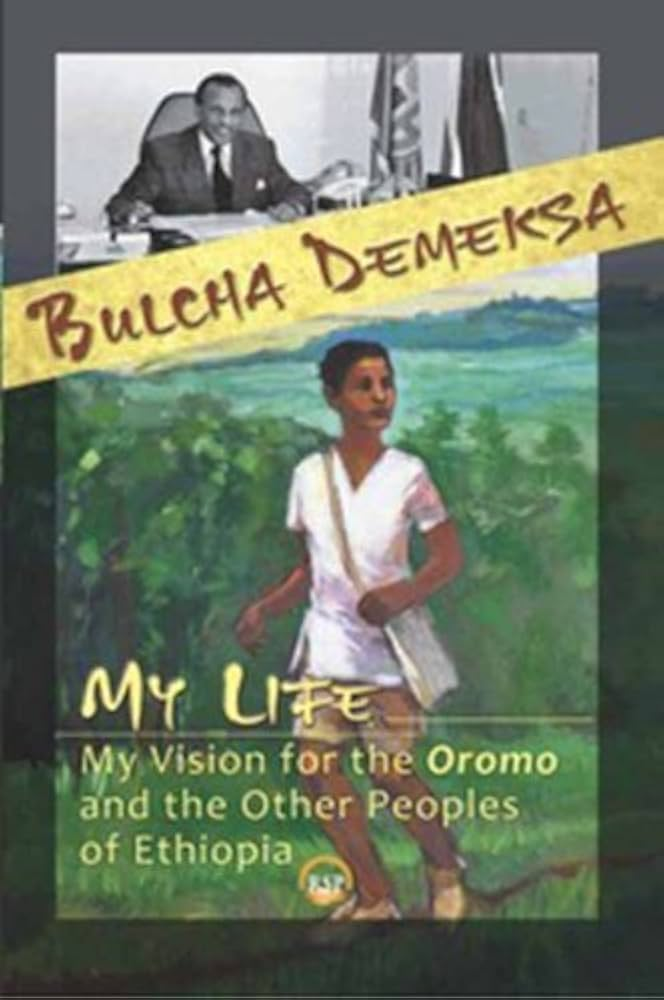
My Life: My vision for the Oromo and Other Peoples of Ethiopia. The Red Sea Press, 2013.Xiii, p281. $34.95 (amazon).
Note:
This is not a book review in the traditional sense. Instead, what follows is a personal reflection on an issue where the author and the reviewer found themselves in diametrical opposition.
Introduction
The autobiography of the late honorable Bulcha Demeksa, My Life was published in 2013. It was reviewed by Prof. Ghelawdewos Araia, also published in 2013. The author and the reviewer diverge sharply on some key issues. This reflection was motivated by my close reading of the book and the review. Here the focus is on one of their most contested points: Finfinnee versus Addis Ababa controversy.
I found Obbo Bulcha’s autobiography deeply captivating. Though the tone seems dispassionate, he delves into thorny issues and forces you to grapple with them; wrestle with their implications. His writing pushes you to imagine the deeper contradictions at the heart of the Ethiopian politics: contradictions between legal theories and lived realities, between constitutional promises and political practices, between historical truths and modern conveniences. Grounded in lifetime of learning and profound yearning for freedom, justice and equal opportunity, Bulcha’s writing emerges as a thoughtful intellectual intervention into the Ethiopian political impasse. Without antagonizing voice, he demonstrates with clarity why genuine federalism is indispensable for Ethiopia future. Moreover, with his characteristic wisdom, Bulcha offers the language, logic, and the intellectual framework necessary for the Oromo pursuit for genuine federalism. He provides the tools to challenge the status quo peacefully from within.
Finfinnee versus Addis Ababa controversy
Obbo Bulcha deliberately, and intentionally, used Finfinnee, the original name of Addis Ababa, throughout his book when referring to the capital city of Oromia regional government and/or the seat of the federal government, except on page 24, and when referring to names of institutions.
However, Prof. Araia, in his review of the book: My Life: My vision for the Oromo and Other Peoples of Ethiopia, pushes back on the use of Finfinnee. In his review subtitled “Obbo Bulcha, dubbiin kun maal isini fayyadhaa?”, a repurposed rhetorical question, Prof. Araia argues against reviving the name Finfinnee. Araia concedes thatFinfinnee was indeed the original name of Addis Ababa, yet insists that “Addis Ababa” is now irreversible. He says “I am unable to fathom the purpose of a name that is not attributable to the capital of Ethiopia and to which other non-Oromo Ethiopians and foreign nationals cannot relate to, page 2.” He further states that “although it is politically correct to revive names such as Bishoftu for Debre Zeit and Adama for Nazareth, I don’t think readers will understand the replacement of Addis Ababa by Finfinnee.”
Finfinnee carries enormous cultural, spiritual and historical significance for the Oromo struggle for peoplehood and genuine self-rule within a federal system. Thus, an uncritical defaulting to Addis Ababa fails to account for the fact that Finfinnee is an enclave in the heart of Oromia; an enclave that since the conquest served as a staging ground for economic exploitation and political control of the conquered provinces2” and from where successive Ethiopian regimes have attempted to erase Oromo narrative, including banning the use of Oromo language, celebration of Irreechaa and the Gadaa system.
It took the Oromo people about 150 years to proudly and publicly celebrate Irreechaa Thanksgiving in Finfinnee.
According to Prof. Araia, “Addis Ababa is irreversible because it evokes the central locus of the African Union headquarters as well as the hub of international organizations, diplomatic missions, and global trade linkages associated with the name.”
If it is “politically correct” to revive names such as Bishoftu, Adama, etc., how come this same logic does not apply to Finfinnee?The claim that Addis Ababa is irreversible because it has become the hub of the AU, international organizations, diplomatic missions, and global trade linkages, confuses diplomatic convenience with historical truth. Finfinnee existed long before Menelik ascended to power, and long before embassies arrived in Finfinnee.
Also, countries and cities change names all the time to reflect historical truth or political shifts: New Amsterdam became New York, Léopoldville became Kinshasa, Salisbury became Harare, and Bombay became Mumbai. The world adapted. Surely, the world can learn Finfinnee too.
Yes, using both names together or interchangeably can be meaningful. But not because Addis Ababa is the ‘irreversible’ default. Rather, interchangeability reflects the layered history of the city. Finfinnee being the indigenous name of the land, and Addis Ababa, the name born of conquest, and by virtue of being the seat of the federal government, and tied to international diplomacy.
To erase Finfinnee is to erase the memories of the original inhabitants of Gulallee and Galaan; memories of the Abichuu, of the Eekka, Sululta and Laga Xafo’ and the living memories of the Tulama Oromo. These communities inhabited these lands long before Empress Taytu Betul became fascinated with the hot springs, aka Finfinnee. True interchangeability demands equal weight to both names. Otherwise, we risk reproducing the very hierarchy that conquest created.
Keeping the status quo is easy, it requires no intervention, but keeps erased memories buried. Reclaiming Finfinnee challenges the status quo. That is bold.
Making “Addis Ababa” the default name instead of “Finfinnee” is not a factual or neutral academic choice. It is a political act that reinforces an imperial narrative. The symbolic fight over the name is not just semantic, it is deeply tied to the struggle for political power, resources control, and the constitutional rights of the people and the state of Oromia regarding the capital city within it.
As a seat of the Federal Government, Finfinnee belongs to Oromian (all residents of Oromia, irrespective of ethnic origin) as it belongs to any other ethnic or nationality group elsewhere in the country. However, as an Oromian city, a city within the state of Oromia, and as stipulated in article 49, the FDRE constitution recognizes the special interest of the state of Oromia in Finfinnee/Addis Ababa, regarding the provision of social services, the utilization of natural resources, and joint administrative matters, as well as other similar matters, shall be respected.”
However, for over 30 years, no further clarification on the execution of article 49 has ever been addressed. Indeed, the EPRDF’s 2000 attempt to relocate Oromia’s capital from Finfinnee to Adama was unconstitutional and emblematic of the exclusionary foundations of the “Ethiopian” narrative.
Concluding his review of the book, Prof. Araia re-echoes the rhetorical question officials of the Election Board put to Obbo Bulcha: “Brother Bulcha, what does this thing benefit you?” In fact, Prof. Araia subtitled his review of the book: Obbo Bulcha, dubbiin kun maal isini fayyadhaa?
By re-echoing the rhetorical question posed by election officials in 1995, 18-years later, Prof. Araia appears to advance a series of implied challenges: Brother Bulcha, why insist on restoring the name Finfinnee when Addis Ababa is, in his view, the default? Why advocate “messy” ethnic federalism? Ultimately, what benefit does your vision for the Oromo and other peoples of Ethiopia offer you or the people?
The othering of Oromo narrative is to erase Oromo narrative. It is an integral part of imperial project. Resisting the writing, singing or saying such indigenous names is no different. But if writing, singing or saying such indigenous names troubles “us”, how can a political system possibly handle the real, tangible demands for historical recognition of rights that such names represent? Also, the question is: Who has the right to write our narrative? Who has the right to write our narrative vis-a-vis the so-called nation narrative that is exclusionary; that perpetuates “othering” of Oromo and other southern nations and nationalities narratives?
Final word
“My Life” is a worth reading. I highly recommend for the Oromo to read it. In fact, it is invaluable read for anyone interested in Ethiopian political landscape. With his characteristic wisdom and dispassionate reasoning, Bulcha offers the language, logic, and the intellectual framework necessary for the Oromo and other peoples of Ethiopia pursuit for genuine federalism. He provides the tools to challenge the status quo peacefully from within. Like the book, the review is also invaluable as it enriches the book by providing a different perspective.
Comment on the book and the review
An error that appeared in the book was repeated in the review. In the Afaan Oromoo version of the rhetorical question, there was an error in the verb used, see p204 in the book or p1 & 12 in the review. The original reads:
“Obbo Bulcha, dubbiin kun maal isini fayyadhaa?”
(Intended meaning: Brother Bulcha, what does this thing benefit you?)
The correct verb should be fayyadaa, not fayyadhaa.
- Correct: Obbo Bulcha, dubbiin kun maal isini fayyadaa?
- Incorrect: …fayyadhaa?
The verb fayyada(a) conveys benefit, which is appropriate here. In contrast, fayyadhaa is used in greetings or to ask about someone’s well-being, and does not carry the intended meaning of benefit. This error appears both in the book and the review, where the controlling verb in the Afaan Oromoo version is misspelled. Correcting it ensures that the rhetorical question accurately conveys the intended meaning.
References
1. Ghelawdewos Araia. (review) My Life: My Vision for the Oromo and Other Peoples of Ethiopia 2. Benti, G. (2002). A nation without a city [a blind person without a cane]: The Oromo struggle for Addis Ababa. DOI: https://doi.org/10.1353/nas.2007.0009
*The author can be reached at ibsaabdi52@gmail.com
 Oromedia