A Commentary
By Dereje Hawas
History, in its relentless and indifferent march, possesses a singular talent: it exposes the fragility of narratives constructed on the shifting sands of ambition and deceit. For a time, Prime Minister Abiy Ahmed appeared to be a master narrator, weaving tales of national unity, inevitable victory, and historical destiny with the fervor of a prophet. The war in Tigray was to be his defining chapter—a swift, surgical operation to restore constitutional order. Its heroes were clear: the Eritrean forces (Shabia) and the Amhara nationalist militias (Fano), cast as liberators and restorers of a stolen patrimony. Its objective was unambiguous: the collapse of the Tigrayan leadership and its reintegration, subdued, into his renewed Ethiopian project.
But history does what history always does. It bends, turns, and escapes the control of even the most eloquent of men. The narrative of swift victory crumbled against the stubborn reality of Tigrayan resistance. The war dragged on, revealing not a surgical operation but a devastating chasm of human suffering. The ultimate, undeniable truth was etched not in Addis Ababa’s press releases, but in the Pretoria Agreement of November 2022. That document, borne of exhaustion and a military stalemate, settled the war’s core, unspoken premise: Tigray could not be defeated by force of arms, and it would not politically collapse under Abiy’s rule.
Pretoria was more than a ceasefire; it was a seismic event that shattered the premier’s carefully constructed war story. It forced an immediate and cynical pivot. The heroes of yesterday—the foreign armies and allied militias he had empowered—instantly became inconvenient. The language of the war changed overnight. The triumphant rhetoric of “እዳው ገብስ ነው” (“Its debt is wheat,” a taunt implying Tigray’s subjugation) and the bold promises that Fano would march “from Gondar to Ogaden” to restore order, evaporated into the thin air of diplomatic necessity.
This is where Abiy Ahmed’s peculiar talent is laid bare: an almost preternatural ability to stand at every sharp turn of history and adopt a new, contradictory lie without blinking. The architect of a coalition that unleashed hell upon Tigray and openly courted forces that threatened Oromia now presented himself as the sober statesman securing peace. The man who once implicitly endorsed the territorial and ideological ambitions of hardline Amhara nationalism now positioned himself as the guardian against “extremism.” Each pivot is executed with a straight face, a rewriting of the past so audacious it demands a collective amnesia.
For Oromia, Pretoria carried a grim, unspoken lesson and a narrow escape. The agreement revealed that the “untrained, undisciplined militias”—once hailed as saviors—could not simply march into Oromia to collect their envisioned “reward” for services rendered in Tigray. Had the military outcome been different, a triumphant coalition of Abiy, Isaias Afwerki, and Fano would have been unleashed with its full fury upon Oromia, the perceived final obstacle to a reconstituted, centralized empire. In this light, Tigray’s resistance, however catastrophic for its own people, inadvertently acted as a breakwall against a tidal wave that would have targeted Oromia next.
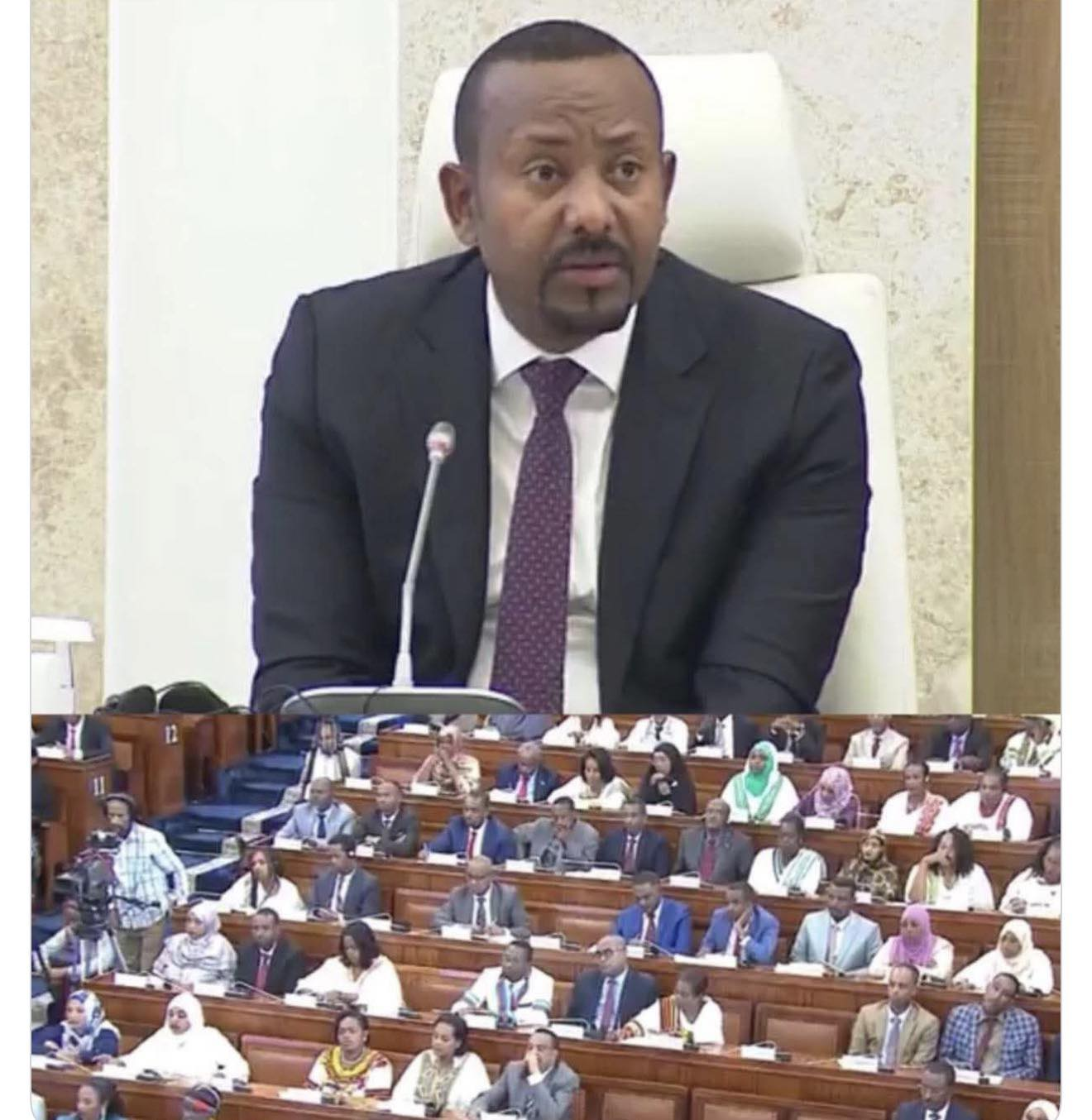
Now, we witness the latest act. The same leader stands before a pliant parliament, spewing new falsehoods about the war’s origins and his own role, attempting to bury the evidence of his past alliances and miscalculations under a mountain of fresh rhetoric. But the ghost of Pretoria haunts him. It stands as an immutable marker that his most violent gamble failed. His narrative of inevitable control has collapsed, revealing instead a pattern of desperate adaptation, where principles are sacrificed at the altar of political survival. The chair in 4 Kilo may remain, but the authority to define history has slipped from his grasp, reclaimed by the stubborn, unforgiving facts on the ground. The story is no longer his to tell.
 Oromedia