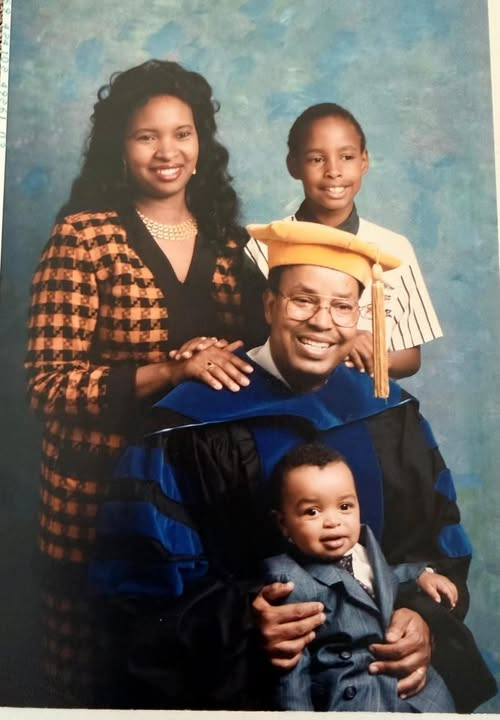
From Mount Mul’ata to the University of Georgia – Who is Professor Mohammad Hassan?
He is regarded as one of the foundational figures responsible for bringing Oromo history to the world’s attention. Professor Mohammad Hassan is among the pioneers of documented Oromo history. His research is credited with dismantling long-held misinterpretations of Oromo political, social, and cultural identity. He is recognized as a trailblazer for subsequent generations of Oromo scholars and provided essential groundwork for future researchers. He devoted most of his life to research and teaching.
He authored two major works on Oromo and Ethiopian history and over a hundred scholarly articles. He currently lives in exile. Recently, the Oromo community in Georgia, USA, honored his lifelong contribution to the Oromo cause.
From the Countryside of Mount Mul’ata to an American University
He was born in the early 1950s in Laga Manyoo, Baddannoo district, in Eastern Hararge’s Mount Mul’ata area. He completed his elementary education in Harar city and his secondary education at the Dabrabirhan Teachers’ Training Institute. He earned his first degree in History from Haile Selassie I University (now Addis Ababa University).
Professor Hassan recalls that at that time, the university was the only one in the country and he was determined to excel in his studies. He remembers receiving his diploma directly from the Emperor. He served as a teacher and participated in community service programs during both the Imperial and Derg regimes at teachers’ colleges in Jimma, Harar, and the Ogaden.
Later, in 1977, he won a scholarship to study abroad and traveled to the United Kingdom, where he completed his Master’s and PhD at the University of London. His PhD research focused on Oromo history. The resulting work was published under the title The Oromo of Ethiopia: A History 1570–1860, a book that has been reprinted many times and reached a global audience.
After completing his studies in London, he was offered a research fellowship in the United States, which led him to permanently settle there. Since first arriving in America in 1985, he has made it his home. For the first three years, he taught African and World History at Atlantic University and Morehouse College in Atlanta. For the next three years, he taught at New York University. From 1992 until 2017, when he entered retirement, he served for 25 consecutive years as a professor at Georgia State University.
What Inspired Him to Research Oromo History?
Professor Hassan’s research primarily centers on Oromo history. He traces his inspiration to his first-year university history lecturer at Haile Selassie I University, a Hungarian scholar named Borsányi, who was sent by UNESCO.
“I had never met someone so profoundly knowledgeable. Studying with him for a year had a huge impact on me. I, too, wanted to become like him. Truthfully, before entering university, my ambition was to attend law school, but this man [Borsányi] convinced me to pursue history.”
“He would come to class without a single note and teach for an hour without even glancing at a book, explaining everything so clearly… I had never met anyone like him in my life. He sparked my interest in history and inspired me to research the history of my own people.”
“Especially regarding our people’s history—at that time, nothing substantial had been written about the Oromo. What was written diminished and insulted our people, portraying them as a people without culture or civilization, roaming like cattle… No people emerges from the earth to wander aimlessly. Our people were depicted in that false light. That should not be; a people must have a true, documented history. That conviction is what motivated me.”
While studying at the University of London, he found that the works of European scholars on Oromo history and identity significantly aligned with his own research, providing him with a substantial foundation.
“What motivated me was that so little had been written about the Oromo, and even that was negative. It did not portray our people in a good light, did not present them as a people with history, culture, civilization, or a history of statehood. Therefore, I immersed myself in the records left by European travelers and missionaries who were in our country 200 years ago—what they wrote and left behind. History must be based on evidence; it cannot be propaganda.”
“…The British Library holds a great deal [of material]; its strength is in the English language. Many French travelers also came. One of them, for instance, wrote about how Oromo assemblies (caffee) were conducted, how leaders were elected, and how meetings were organized. He compiled this into 27 folders. Asking questions, conducting interviews, and working with what he witnessed… delving into this material took me months. I didn’t even know French—just a little. I had to take evening classes, and a dictionary helped me. This man truly wrote in a way that revealed our people; he noted, for example, that the Gadaa system and the English Parliament were similar.”
What Do His Colleagues Say About Him?
Professor Hassan is the author of two seminal books on Oromo history and has co-authored four others with fellow scholars. He has written over a hundred articles, and his work forms a core part of the academic discourse on Oromo history. He was a founding member of the Oromo Studies Association (OSA) and served in its leadership.
Oromo Liberation Front (OLF) leader Obbo Xahaa Alii, a childhood acquaintance, states that his contribution lies in “pursuing the academic study of Oromo history; those who hated it could not erase the true history he established.” Obbo Xahaa adds that his research has also supported the Oromo struggle and diplomatic efforts.
“Subsequently, freedom fighters and those who wrote and taught history followed the path he paved and amplified the Oromo identity and cause on the platform he built. He set an example for others and also provided diplomatic support.”
“He achieved what he set out to do. A person with a clear vision, purpose, and determination, who does not abandon what he believes in, who is committed to work, and who does not neglect his duty—that is his strength.”
Another colleague, Obbo Ibsaa Ahmad, describes him as “a respectful person who respects and loves everyone, younger and older—a true patriot.”
Professor Hassan is also known for assisting Oromo refugees abroad, helping them by submitting documents to the U.S. State Department and UNHCR to facilitate their cases.
Life Today
Professor Mohammad Hassan currently lives in exile with his spouse and two children. Recently, the Oromo community in Georgia, USA, organized a ceremony to honor his contributions.
Professor Mohammad Hassan is not only a historian but also an advocate for human rights. He participated in the peace talks in Tanzania between the Ethiopian government and the OLF-WBO as one of the delegates representing the OLF-WBO.
 Oromedia