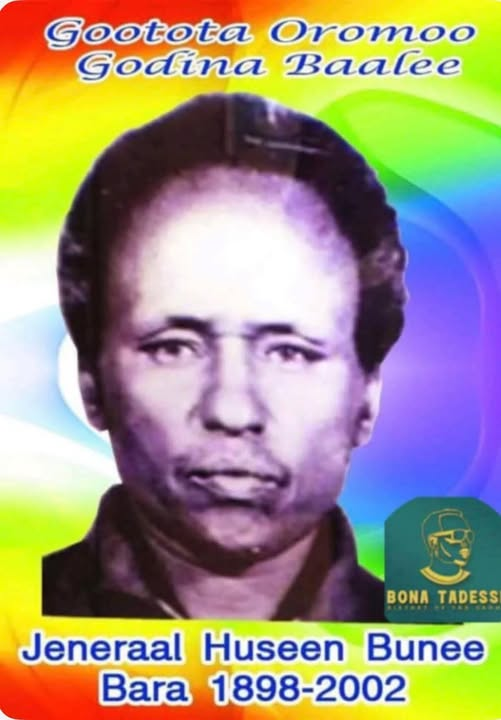
General Hussein Bunee was born in 1898 in Sawweyna, Baale Province. From his youth, he was known as an intelligent and courageous man. Because of these qualities, he rose through the ranks within Haile Selassie’s administration, eventually attaining a senior leadership position. However, during his service, he became deeply aware of the oppression the regime inflicted upon the Oromo people. This realization compelled him to join the struggle for freedom, famously declaring his commitment by selling nine cattle to purchase three rifles and begin his resistance.
In 1962, Hussein Bunee, along with his siblings and comrades, captured the area known as Gaara Goonii (now named in his honor). After repeatedly repelling attacks from Haile Selassie’s forces, he selected eight of his fighters and sent them to Somalia to seek support. The Somali government agreed to assist, providing them with eight rifles, seven grenades, and one machine gun before facilitating their return. Subsequently, in 1963, Hussein Bunee himself traveled to Somalia, securing further supplies of weapons, ammunition, and explosives to continue his armed campaign.
After waging a fierce and prolonged war against the Ethiopian regime, Hussein Bunee relocated his forces to Somalia in 1968, settling in the town of Luuq. Following a seven-year period of rebuilding and strengthening his movement, he returned to Ethiopia to resume the struggle. However, facing increased pressure from the Derg military government, he was forced to return to Somalia. There, in collaboration with other Oromo refugees, he dispatched Hussein Muhammad Sura to Egypt to seek support for their cause. Upon learning of this, the Somali government was angered; they confiscated the aid obtained from Egypt and imprisoned Hussein Bunee and 35 others for five years.
Hussein Bunee perceived that the Somali government’s objective was to co-opt Oromo fighters under a Somali banner, “Abbaa,” to launch attacks. He firmly opposed this plan, stating, “We are Oromo. We want help in our own name, not to be assisted under the Somali name ‘Abbaa’.” For this reason, even after his arrest, when attempts were made to bribe and manipulate him into fighting for their interests, he refused, choosing imprisonment over compromising his principles, declaring, “That is not the goal of our struggle.”
Hussein Bunee was released after three and a half years in prison in 1983. Upon returning to his homeland, he worked within the administrative system of the Derg regime. During this time, when the Oromo Liberation Front (OLF) was banned and forced underground, Hussein, remaining steadfast to the cause of liberation, advised OLF organizers: “The goal we fought for remains the same. True struggle is not only through arms but also through peaceful means. Do not abandon your country; those who remain inside are its rightful owners. Those outside become outsiders. Do not forget this.” He later returned to live in his birthplace, where he passed away on February 14, 2002.
May he rest in peace.
 Oromedia