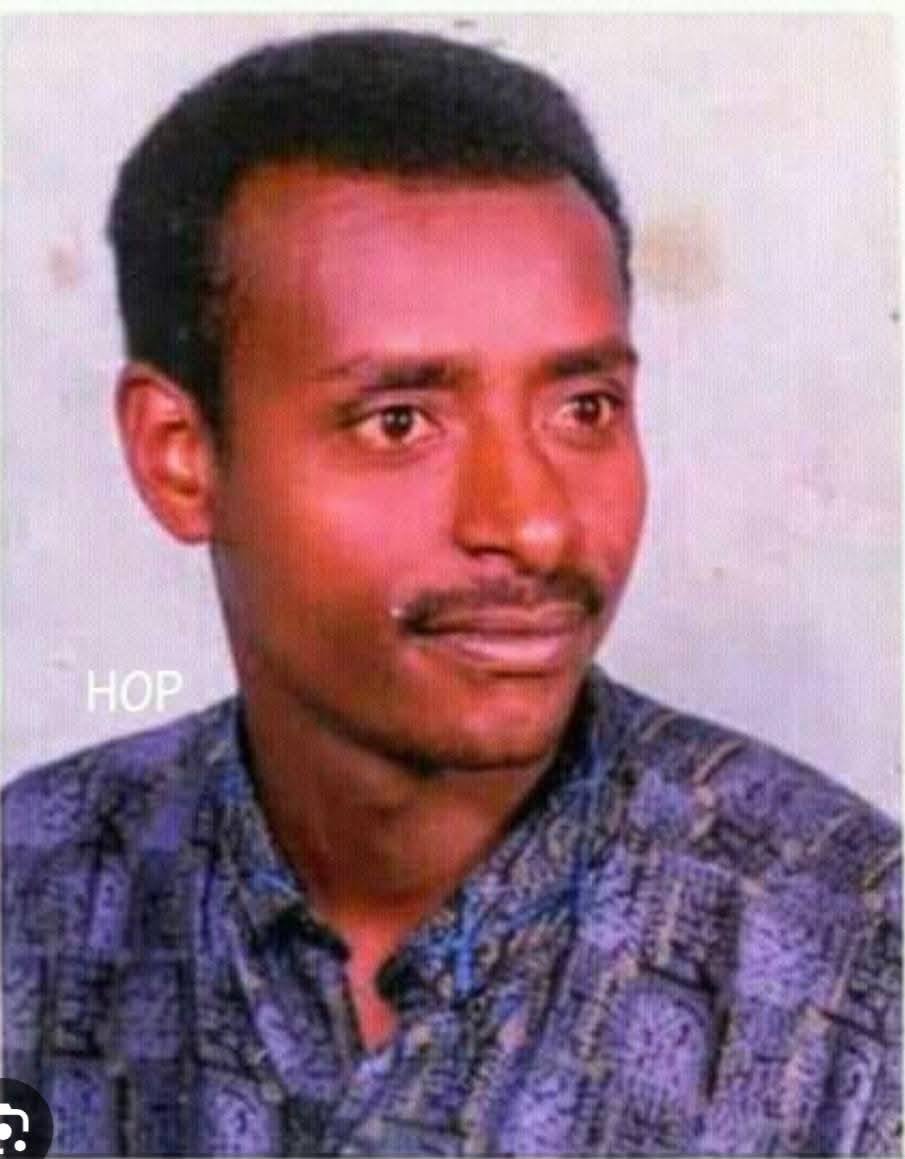
In the annals of Oromo art and resistance, some names echo as anthems, their music a public soundtrack to struggle. Others exist as a haunting silence—a melody cut short, a verse left unfinished. The story of Artist Jireenya Ayyaanaa is both. A gifted vocalist, actor, and cultural archivist, his life was a testament to resilience. His disappearance remains an open wound, a unresolved chord in the symphony of a nation’s memory.
From the red earth of Giddaa Ayyaanaa, Gabaa Jimaata, where he was born in 1963 (1956 Ethiopian calendar), Jireenya’s path was forged early by responsibility. His father’s passing in 1974 left the young boy, the first son, to shoulder familial duties. Yet, within him simmered a profound intellectual and artistic fire.
A Mind That Questioned, A Voice That Defied
“Jireenya had the ability to ask questions from childhood,” recalls his sister, Inkooshee Ayyaanaa Guddataa. “He was persuasive and born with the gift of speech. If he saw something wrong, he wouldn’t let it pass.”
This innate sense of justice clashed with a system designed for erasure. Attending a makeshift church school where instruction was solely in Amharic, the young boy posed a question that would define his trajectory: “Maaliif afaan keenyaan hin barannu, hin barreessinu?”—Why don’t we learn or write in our own language?
The confrontation that followed led to his expulsion. He organized his peers in protest and left formal education behind, but not the pursuit of knowledge. Jireenya became an autodidact, his mind a crucible for history and his heart a vessel for his culture. He moved through life as a farmer, a trader in Gimbi and later Finfinnee (Addis Ababa), all while his true work unfolded in the shadows: studying Oromo history, language, and the mechanics of liberation.
The Stage as a Sanctuary, the Song as a Weapon
Jireenya’s was not a voice meant merely for song. It was an instrument of mobilization. “His goal wasn’t initially music,” Inkooshee explains. “His great focus was on fighting for his people. Later, he chose to use his voice through song for the public. ‘If I fail in other things,’ he said, ‘I must stand with my people through my voice.’”
This conviction led him to the epicenter of Oromo cultural revival in the 1980s. Alongside pioneers like Artist Daagim Mokonnin, Jireenya helped lay the groundwork for what would become the legendary Baandii Gadaa, the first modern Oromo band. Before the band was formally established, they gathered in secret. “We met in hiding, in places like Markaatoo,” Daagim recalls. “Great elders like Abbaa Raayyaa supported us.”
Within the band, Jireenya was a polymath: a singer, an actor who wrote and performed dramas, an event organizer, and even a security coordinator. “He was a planner, a peacemaker, and he loved his work with great excellence,” says Daagim. “Above all, he was not a person who worked for himself.”
Their mission was audacious: to use art to reclaim a language and animate a political consciousness. They performed on rare Oromo-language radio programs and for small, brave audiences, often university students and soldiers, embedding messages of identity and freedom within traditional melodies and new compositions.
The Vanishing: A Life Swallowed by Silence
The relentless activism of Jireenya and his comrades made them targets. In 1987, after a period of intense government surveillance, he was arrested in Finfinnee. The details of his captivity are fragments, glimpsed through the harrowing accounts of others.
His family heard he was taken to a notorious underground prison in Maqalee, Tigray. A driver from his hometown later reported seeing him there, forced with other prisoners to haul stones. The driver claimed Jireenya, recognizing a fellow Oromo, whispered a message of endurance: “Akkam jirtu ijoollee Giddaa! An Jireenyaadha. Hin dubbatinaa ammoo, jabaadhaa!” (How are you, children of Giddaa! I am Jireenya. Don’t talk, but be strong!).
After that, he vanished into the state’s machinery of repression.
The Unending Vigil
For over three decades, Jireenya Ayyaanaa has been a forced absence. His family exists in a purgatory of hope and despair, unable to mourn, unable to cease searching. His sister Inkooshee has become a keeper of his memory and a pursuer of truth, sharing his story with platforms like the BBC, following every lead—a reported sighting in 2006, a blurry social media video years later that proved to be someone else.
“We still look for him,” she states, a testament to a grief that cannot close.
His fellow artist, Daagim Mokonnin, holds a grim certainty. “The brutal and unexpected violence that befell us… what killed him is the war that has been returned,” he says, connecting Jireenya’s fate to enduring cycles of conflict. “If his bones are found in Maqalee, show them to us!”
The Legacy of the Unreturned
Artist Jireenya Ayyaanaa’s story is more than a biography; it is an allegory. He represents the countless voices—artists, thinkers, ordinary people—swallowed by decades of conflict, whose families still wait at the door, listening for a footstep that never comes.
He is the boy who asked “Why?” in a forbidden language. He is the artist who believed song was a form of standing firm. He is the missing person who, through his very absence, continues to ask urgent questions about justice, memory, and the price of identity.
His song was interrupted, but its echo demands an answer. The search for Jireenya is the search for a piece of a nation’s soul, still unreturned. Until there is truth, his melody remains unfinished, a silent refrain in the heart of every Oromo who remembers that to sing is also to remember, and to remember is to refuse to let a life disappear.
 Oromedia