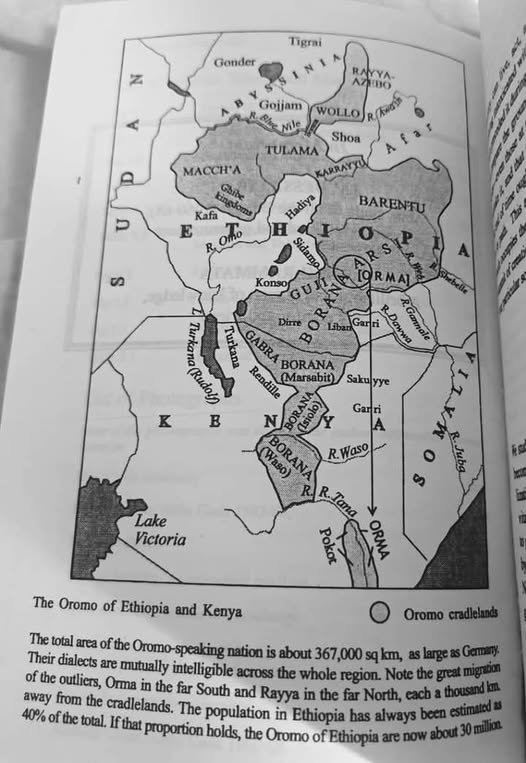
In the complex and often contentious political landscape of Ethiopia, few questions are as fundamental—and as fiercely debated—as the destiny of Oromia and its people. It is a discourse charged with history, pain, and aspiration. Cutting through the noise, a clear and unwavering principle emerges, one that is non-negotiable for the Oromo nation: The choice that determines the fate of the Oromo people and Oromia can only be made by the Oromo themselves. It is not the exclusive domain of any insider or outsider. Any path other than this, the Oromo people are not—and will never be—prepared to accept.
This declaration, echoing the spirit of thinkers like Nadhii Gammadaa, is not a slogan of separation but a foundational statement of self-determination. It asserts that the agency over Oromia’s political, social, and economic future rests solely with its inhabitants. It is a rejection of a long history where decisions affecting Oromia—from land use to language policy to political representation—were made in distant capitals by power structures that viewed the region as a resource to be managed rather than a nation with a will of its own. The message is unequivocal: there can be no lasting solution imposed from the outside.
This principle stands in direct opposition to a historical and, some argue, ongoing project of the Ethiopian state. The article identifies this project as a deliberate strategy to “fragment this great Oromo people into small pieces to diminish them.” This perceived policy of division—whether through administrative gerrymandering, the fostering of internal disputes, or the systematic dilution of Oromo political unity—is seen not as a path to a stronger Ethiopia, but as its fundamental flaw.
The argument posits a critical causality: “An Ethiopia built by suppressing and dismantling Oromo unity, viewing it as a national threat, is not one we can coexist with; abandon that hope.” This is a stark warning. It suggests that a state whose cohesion depends on the subjugation or fragmentation of its largest ethnic group is inherently unstable and unjust. It frames Oromo unity not as a threat to Ethiopia, but as a potential cornerstone for a genuine, voluntary union. Conversely, a unity born of fear and enforced fragmentation is deemed unsustainable.
The logic extends to a regional and global scale: “If you hate Oromo unity because you see it as an obstacle to Ethiopian unity, you will bear no fruit for this country or the Horn of Africa—only loss. Step aside.” This reframes the narrative. It challenges the notion that a strong Oromia weakens Ethiopia, proposing instead that a confident, self-determining Oromia is a prerequisite for a stable and prosperous region. The “loss” warned of is the perpetual cycle of conflict, distrust, and underdevelopment that plagues a union held together by force rather than consent.
The concluding statement serves as both a reminder of reality and a call to action: “A country that has managed and diminished a great people like the Oromo has never existed as a peaceful country in the world. Let us not weaken ourselves by what we have become. The people say: benefit from the strength of the Oromo!”
This is the powerful, dual-edged conclusion. It reminds the world that empires and states built on the subjugation of nations are historically fraught with strife. More importantly, it calls on the Oromo people themselves to shed any internalized helplessness and recognize their inherent power—their demographic weight, cultural resilience, and moral claim. The ultimate message is one of agency and inevitability: the future will be shaped not by those who seek to diminish Oromia, but by the unbreakable will and collective strength of the Oromo people themselves. The choice for Oromia is being made, and it is being made from within.
 Oromedia