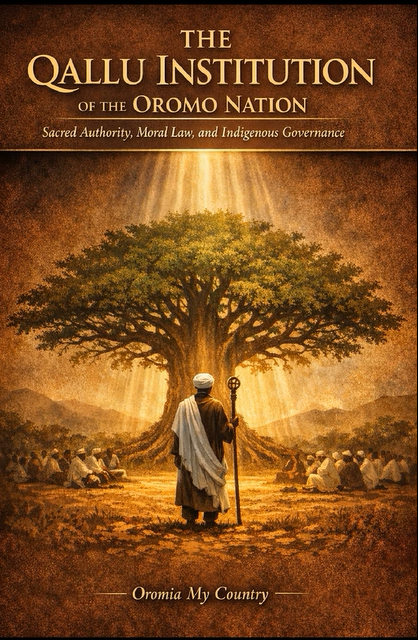
Long dismissed as mere ritual, the ancient Qallu institution—a sophisticated framework of ethics, governance, and environmental law—offers urgent lessons for today’s world.
By Daandii Ragabaa
For centuries, narratives written by outsiders have shaped the understanding of Africa’s indigenous systems. Among the most profound misrepresentations is that of the Qallu institution of the Oromo nation. Often reduced to a footnote of “traditional religion” or “ritual practice,” it has been portrayed as superstition, a primitive artifact to be cleared away by modernity. But what if this view is not just incorrect, but politically convenient? What if, instead, Qallu represents one of humanity’s most sophisticated indigenous systems of moral authority—a constitutional framework that wove ethics, law, and ecological balance into the very fabric of society?
A growing body of scholarship and oral tradition is now reclaiming Qallu not as a relic, but as the central nervous system of classical Oromo civilization. It was not a separate religious sect, but the bedrock of a worldview where governance was a moral act, justice was restorative, and humanity’s contract with nature was sacred law. To understand Qallu is to understand an African philosophy that solved problems modern societies still grapple with: how to check power, heal communities, and live sustainably.
The Foundation: Waaqa and the Law of Safuu
At the heart of the Qallu institution lies Waaqa, the singular, universal source of life and order in Oromo cosmology. Unlike a distant deity, Waaqa is immanent—present in natural law, ethical conduct, and balance. Authority, therefore, does not come from divine mandate, but from moral alignment. A leader’s legitimacy hinges on their adherence to safuu.
Safuu is the moral law of the universe, governing all relationships: between people, communities, humanity and nature, and creation and Waaqa. A breach of safuu—be it injustice, betrayal, or ecological harm—was believed to disrupt cosmic harmony, leading to social strife and environmental consequence. The Qallu’s primary role was to be the interpreter and guardian of safuu, the constant check against the corruption of power.
The Architects of Balance: Qallu and Gadaa
One of the Oromo civilization’s most brilliant innovations was its system of dual governance. Political and administrative power was managed through the well-known Gadaa system, a generational, democratic republic. Moral and spiritual authority, however, resided distinctly with the Qallu institution.
This separation was intentional, creating a built-in system of checks and balances centuries before Montesquieu. Gadaa leaders required the Qallu’s blessing for their authority to be fully legitimized. More importantly, if a Gadaa leader violated safuu—through tyranny, corruption, or abuse—the Qallu had the authority to publicly withdraw moral sanction. This could effectively cripple a leader’s legitimacy, demonstrating that in Oromo political philosophy, power was always subordinate to ethics.
Justice That Heals: Restorative Principles
In a Qallu-led judicial process, the goal was not primarily to punish, but to repair. Drawing from safuu, justice focused on truth-telling, reconciliation, restitution, and the reintegration of the offender into the community. Even in cases of serious conflict, the emphasis was on halting cycles of violence and restoring communal harmony.
This approach mirrors modern concepts of restorative justice, now seen as a progressive alternative to punitive legal systems. For the Oromo, it was simply the logical application of safuu—the understanding that a broken relationship, not just a broken rule, needed mending.
The Sacred and the Secular: Land as Ethical Space
The famous Odaa tree was more than a symbol; it was the practical seat of Qallu authority. Assemblies were held in its open shade, emphasizing transparency and collective witnessing. This points to a core principle: in the Oromo worldview, geography was ethical. Land, forests, and rivers were not economic resources but moral subjects, governed by a sacred trust.
The Qallu institution enforced environmental codes, protecting water sources, governing grazing cycles, and preserving forests. Ecological stewardship was not an environmental policy; it was a spiritual and legal obligation embedded in safuu. To pollute a river or clear a sacred forest was not just practical folly—it was a moral transgression.
Suppression and Silent Survival
The deliberate dismantling of the Qallu institution by successive imperial and colonial regimes was no accident. It was a targeted political strategy. By destroying sacred sites, criminalizing rituals, and marginalizing Qallu leaders, external powers sought to erase the source of Oromo moral and legal legitimacy, making way for systems of control that answered to distant capitals, not to Waaqa or safuu.
Yet, Qallu did not disappear. It survived in the whispered knowledge of family lineages, in the rhythms of adapted rituals, and in the enduring cultural memory of the Oromo people. Its survival is a testament to resilience, a form of quiet intellectual resistance.
A Living System for a Troubled World
Today, as global crises of political legitimacy, social fragmentation, and ecological collapse converge, the principles embodied by the Qallu institution resonate with profound urgency. The concepts of safuu—of interconnected responsibility—and of power checked by moral authority offer not just historical insight, but a framework for the future.
Reclaiming the Qallu is not an exercise in nostalgia. It is an act of recovering a sophisticated African philosophy that viewed law, ethics, and ecology as inseparable. It stands as evidence that solutions to some of our most modern dilemmas—how to hold leaders accountable, how to heal divided communities, how to live within our ecological means—were being practiced in the Horn of Africa long before the colonial encounter.
The Qallu institution reminds us that some of the most advanced ideas are not always the newest, and that the path forward may require listening to the deep, moral wisdom of the past.
—
This article is based on emerging scholarship and oral historical research reclaiming indigenous Oromo systems of knowledge and governance.
 Oromedia