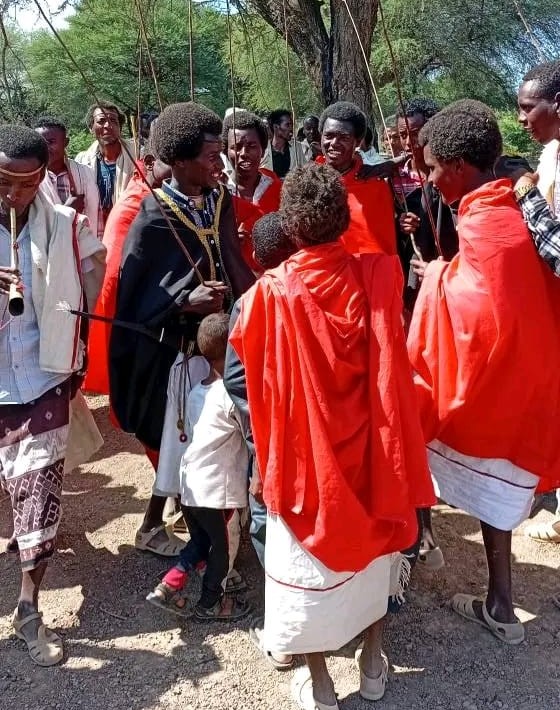
OROMIA, ETHIOPIA – Beyond the rolling highlands and within the social fabric of the Karrayyu Oromo, time is not merely counted in years but measured in the majestic, cyclical rhythm of the Gadaa system. It is not just a political institution but a complete cosmological order—a living code that governs life, leadership, and legacy. A recent, detailed exposition by Gadaa scholar Dilboo Bookaa offers a rare key to understanding this sophisticated indigenous democracy, revealing it as “the marker and identity of the Oromo, the definer of relationships, and the governor of the assembly.”
The system is presented as a triad of inseparable elements: Gadaa as the System, Gadaa as the Period, and Gadaa as the People. It is a profound social contract designed not by man alone, but built upon the “natural law of God” (heera uumaa Rabbii), governing the transition of power across generations with precise, irrevocable rules.
The Pillars of Authority: Bokkuu, Qaalluu, and the Unbroken Cycle
At its heart are two sacred pillars of authority. The Bokkuu (scepter) embodies political and judicial leadership, held by the Abbaa Bokkuu. Its blessing is mandatory for any ritual, and its bearer is a figure of immense sacrifice, described as one who “binds courage in his stomach, stakes his life, and enters the arena.” Its counterpart is the Qaalluu, the spiritual authority who intercedes for peace, rain, and fertility.
Power rotates every eight years among five Gadaa assemblies or Tuuta: Michillee, Halchiisa, Roobalee, Dirmajii, and Meelbaa. Each assembly progresses through five internal grades (Gulantaa): Dabballee (Child), Foollee/Caasaa (Junior), Siidaa (Initiate), Goobaa (Senior), and Doorii (Retired Elder). An individual’s life is thus synchronized with this public cycle, creating a seamless transfer of responsibility from father to son.
A Dance of Generations: Mathematics of Social Harmony
The article demystifies the complex mathematics that ensures harmony. A man is simultaneously in two cycles: his biological age and his Gadaa grade. A father in the Doorii (retired elder) grade of the ruling Michillee assembly, for instance, will have his son in the Dabballee (child) grade of the same assembly. They are politically “brothers” within Gadaa, despite being father and son biologically.
The author provides a stunning calculation to illustrate the system’s self-correcting precision. By tracking the current positions of the five assemblies, he demonstrates how their respective 8-year cycles interlock perfectly. For example, if the ruling Michillee is in its 6th year of leadership, the next assembly, Halchiisa, must be in its 30th year within the broader 40-year cycle that spans all five groups. This mathematical elegance ensures no overlap or power vacuum, proving the system’s internal coherence forged over centuries.
Symbolism Woven into Being: The Language of Attire
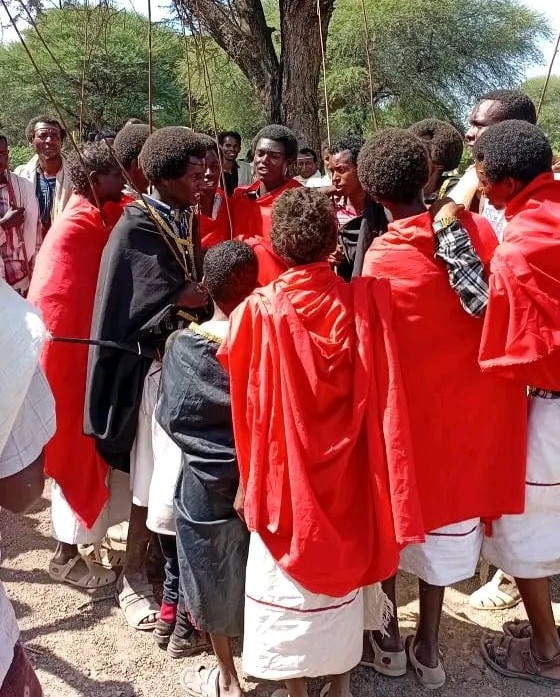
Every aspect of Gadaa is symbolic, especially attire during ceremonies. The Baqqala (red garment) and Kaabbaa (black garment) are not mere cloth but profound statements.
- The black Kaabbaa symbolizes divine majesty (ulfina Waaqaa) and political sovereignty. Worn by the Qaalluu, it represents authority derived from God.
- The red Baqqala, adorned with the faajjii (cross), is the implement of the Abbaa Bokkuu. Its redness represents governance and law, the cross symbolizing the fourfold governance structure of Gadaa.
- White represents the pure, united community living under this divine and political covenant.
A System for All Time: More Than Democracy
Ultimately, the Karrayyu Gadaa is revealed as a totalizing framework for sustainable existence. It is an autonomous, self-perpetuating system where, as the text states, “the period waits for no one; the child is prepared for the grade.” The system itself is the constant, patiently ensuring that each generation is trained, initiated, and elevated to lead, thus preserving the identity, law, and continuity of the Oromo people against all odds.
In an era of fragmented governance, the Karrayyu Gadaa stands as a monumental testament to a different kind of order—one of cyclical renewal, intergenerational equity, and a sacred balance between the human, the natural, and the divine. It is not merely history; it is a meticulously active, living dialogue with time itself.
 Oromedia