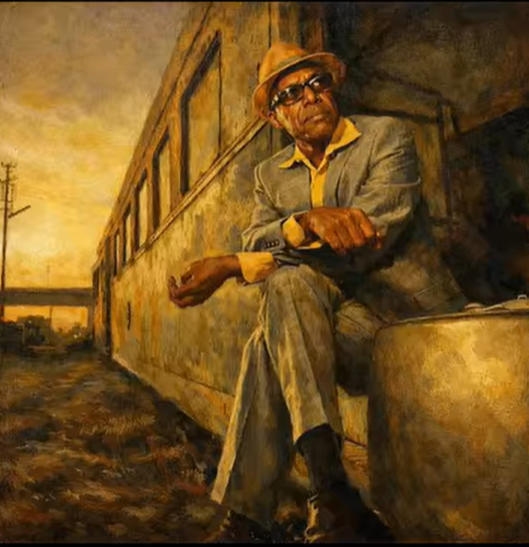
How one man’s voice became the vessel for a people’s memory, identity, and unbroken spirit.
In the quiet before a performance, as the stage lights warm and the hum of anticipation fills the air, an archive prepares to speak. Not one of dust and parchment, but of breath and vibration. For the Oromo Nation, Dr. Ali Birra was never merely a singer or a musician. He was, and remains in his passing, a carrier of collective memory—a living, breathing library whose catalog was written in melody and whose legacy is etched in the heart of a culture.
His voice did not simply entertain; it remembered. In a world where colonial and post-colonial forces often sought to marginalize, silence, and fragment the Oromo people, Dr. Ali Birra’s music became a sanctuary for identity. Through his songs, Oromo history learned to remember itself.
The Oral Library: Where Memory Found a Melody
When written expression was constrained and linguistic heritage pushed to the periphery, Dr. Ali Birra built an oral library. His vast repertoire—spanning soulful balballaa, defiant anthems, and poetic love songs—became the shelves upon which the Oromo experience was stored. Each composition held fragments of a collective journey:
- “Hin Yaadin” (Do Not Be Sad) became an anthem of resilience, soothing the wounds of displacement.
- “Aadaa Bari” stood as a proud manifesto of culture, a declaration of existence.
- His love songs, like “Uumamu”, intertwined personal emotion with a deeper, cultural affection for land and community.
His lyrics in Afaan Oromo did more than communicate; they preserved. They safeguarded the language’s proverbial wisdom, its poetic rhythms, and its philosophical depth for generations who risked losing their linguistic compass. The music carried the cultural rhythm—the pulse of geerarsa (praise poetry), the soul of ceremony, the heartbeat of daily life—into homes, cars, and headphones across the globe.
The Bridge Between Generations
Dr. Ali Birra’s genius lay in his role as a human bridge. For elders, his songs were echoes of a lived past—a soundtrack to their youth, their struggles, and their joys. Hearing “Birraan Bari” was not just listening to a song; it was a temporal homecoming.
For the youth, especially those in the diaspora born far from Oromia, his music became inherited memory. It taught them who they were before the world could tell them otherwise. It provided a sonic map to an identity they could feel before they could fully articulate it. In this way, he performed the sacred work of continuity:
- Between past and present: Translating ancient ethos into contemporary resonance.
- Between homeland and exile: Making the odaa (sycamore tree) shade listeners in Minneapolis, Toronto, and Stockholm.
- Between tradition and modernity: Weaving the krar and masanqo with contemporary arrangements, ensuring tradition evolved without erasure.
The Keeper, Not the Kept
Conventional history often treats figures as subjects to be recorded and assessed. Dr. Ali Birra reversed this dynamic. He is not remembered by history; he remembered history for the Oromo Nation. His voice was the recording device, his albums the historical texts. He stored what could not be safely written and carried lyrics across borders where books might be stopped.
His melodies held the unspeakable—the longing, the pride, the pain of a people—and gave them a safe, beautiful, and enduring form. He sang not to escape reality, but to encode it into the cultural DNA, ensuring that no amount of suppression could erase the memory held in a widely sung chorus.
An Enduring Soundscape of Identity
The legacy of Dr. Ali Birra is a living soundscape. It is the playlist of Oromo identity—a rhythm of survival that continues to pulse. In classrooms where Afaan Oromo is now taught, in protests where freedom is demanded, in living rooms where weddings are celebrated, his voice remains the connective tissue.
He showed that memory can be a melody, and that resistance can be a rhyme. He proved that a culture’s soul could be kept safe not in a vault, but in a song, passed from one generation to the next, growing richer with each refrain.
In ensuring his people would never forget themselves, Dr. Ali Birra achieved the ultimate artist’s purpose: he became inseparable from the story he told. The archive is silent now, but its echoes are eternal, reverberating in the continued struggle, celebration, and unwavering existence of the Oromo Nation. He is the memory that sings on.
 Oromedia