A Nomination for Inscription on the UNESCO Representative List of the Intangible Cultural Heritage of Humanity
Heritage Domain: Knowledge and Practices Concerning Nature and the Universe
Community: Oromo People of the Horn of Africa
1. Introduction
The Indigenous Oromo Calendar, known as Dhahaa or Hennaa, represents one of the oldest continuously practiced indigenous time-reckoning systems in Africa. It is a sophisticated astronomical, cultural, legal, and philosophical system developed by the Oromo people through sustained observation of the moon, stars, and cosmic cycles.
Unlike modern linear calendars, Dhahaa is cyclical, cosmological, and communal, governing not only agricultural seasons but also law, governance, ritual life, ethics, and intergenerational responsibility through the Gadaa system.
This nomination seeks recognition of Dhahaa as a living intangible heritage, preserved through oral transmission, ritual enactment, and the specialized knowledge of Ayyaantuu—Oromo time-keepers and astronomer-philosophers.
2. Identification of the Element
Name of Element:
Dhahaa / Hennaa – The Indigenous Oromo Calendar System
Geographical Distribution:
Practiced across Oromia and among Oromo communities in Ethiopia, Kenya, and the global diaspora.
Cultural Bearers:
- Ayyaantuu (time experts)
- Gadaa leaders
- Elders (Jaarsa)
- Ritual specialists
- Oral historians
3. Historical Origins and Antiquity
According to Oromo oral history, archaeological interpretations, and comparative astronomical studies, the Dhahaa calendar was developed around 300 BCE, making it contemporaneous with ancient Nile Valley civilizations.
Oromo elders, supported by manuscripts such as DAANIYAA, maintain continuous counting of Gadaa cycles for over 6,400 years, placing the present Oromo year at approximately 6418.
This uninterrupted chronological memory represents one of humanity’s longest preserved indigenous temporal records.
4. Cosmological and Astronomical Foundations
Dhahaa is a lunar-stellar calendar, based on:
- The synodic cycle of the moon
- Observations of specific stars and constellations
- Seasonal alignments and ecological indicators
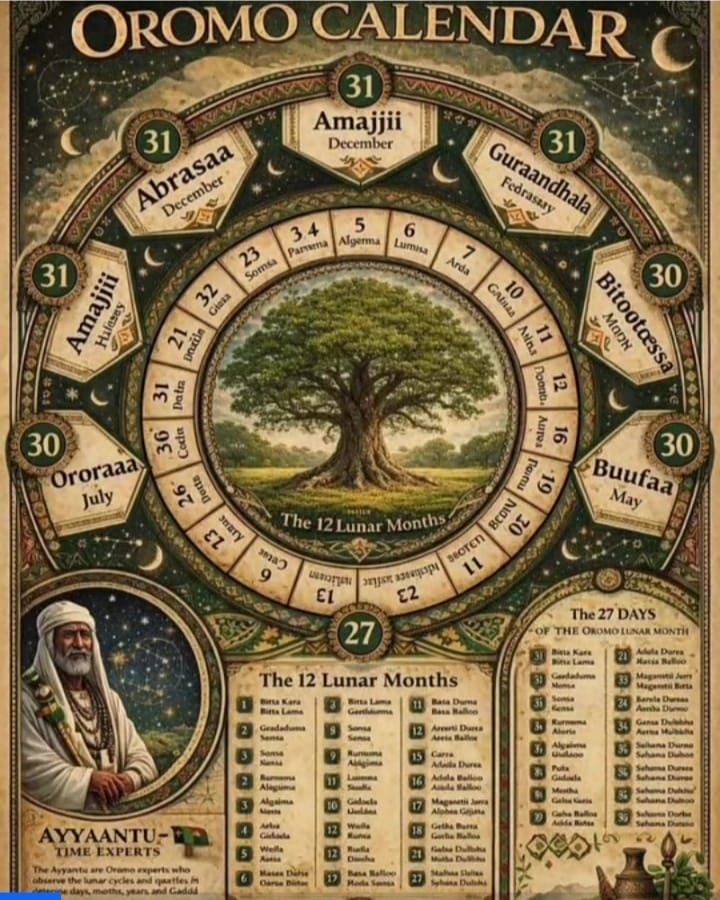
The calendar consists of 12 lunar months, totaling 354 days, with no concept of weeks—reflecting a worldview where time flows through observation, not abstraction.
Role of the Ayyaantuu
The Ayyaantuu are trained custodians who:
- Observe lunar phases
- Track stellar positions
- Determine days, months, years, and Gadaa periods
- Advise communities on ritual timing, governance transitions, and seasonal planning
Their knowledge is transmitted orally through apprenticeship, poetry, and ritual practice.
5. Structure of the Oromo Calendar
The Twelve Lunar Months
- Mudde/ Abraasaa – December
- Amajjii – January
- Guraandhala – February
- Bitooteessa – March
- Ebla – April
- Caamsaa/Buufaa – May
- Waxabajjii – June
- Adoolessa/ Oboraa Guddaa – July
- Hagayya/ Oboraa Xiqqaa – August
- Fulbaana/ Birraa – September
- Onkoloolessa – October
- Sadaasa – November
Among these:
- Four months contain 31 days
- Eight months contain 30 days
6. The Twenty-Seven Named Days
Each lunar month contains 27 named days, each carrying cultural meaning:
- Bitta Kara
- Bita Lama
- Gardaduma
- Sonsa
- Sorsa
- Rurruma
- Algajima
- Lumasa
- Arba
- Gidada
- Walla
- Ruda
- Basa Duraa
- Basa Balloo
- Areeri Duraa
- Areerii Balloo
- Carra
- Adula Duraa
- Adula Balloo
- Maganatti Jarra
- Maganatti Britti
- Garba Duraa
- Garba Ballaa
- Garba Dullacha
- Salbana Duraa
- Salbana Ballaa
- Salbana Dullacha
For months exceeding 27 days, initial names are cyclically repeated.
This naming system embeds time with language, transforming days into remembered entities rather than numerical units.
7. Spiritual Philosophy and Waaqa
The Oromo believe in a single supreme creator, Waaqa, expressed in the proverb:
“Gurraacha garaa garbaa, tokkicha maqaa dhibbaa.”
(The One who is black and vast, the single one with hundreds of names.)
Dhahaa does not function merely as a calendar, but as a theological narrative of creation, ethics, and cosmic order.
8. Sacred Months and Creation Narratives
- Mudde (December)
On the 15th day, Waaqa created Day, Month, and Earth. Marks the establishment of cosmic order. - Ebla (April)
Creation of horses. Pillars of the earth fixed after moral imbalance. Month of cosmic stabilization. - Waxabajjii (June)
Humans seek Waaqa’s mercy. Cultural life and Gadaa law enactment begin. Central month of governance and ethics. - Fulbaana (September)
Waaqa saddened by human transgressions. Creation of harmful creatures. Symbolizes moral consequence. - Sadaasa (November)
Creation of sheep and coffee. Waaqa withdraws after giving laws. Transition into responsibility and autonomy.
These narratives encode environmental ethics, accountability, and balance.
9. Dhahaa and the Gadaa System
Dhahaa is inseparable from Gadaa, the Oromo system of democratic governance.
- Each Gadaa period lasts eight years
- Leadership transitions are synchronized with celestial cycles
- Law, ritual, and authority are regulated by time—not individuals
This integration makes Dhahaa a constitutional calendar, regulating political power through cosmic order.
10. Social, Cultural, and Ecological Functions
Dhahaa governs:
- Agriculture and pastoral cycles
- Ritual ceremonies (Irreecha, blessings, transitions)
- Legal enactments and conflict resolution
- Ethical conduct and community responsibility
It aligns human activity with nature’s rhythm, ensuring sustainability.
11. Threats and Safeguarding Needs
Threats:
- Colonial and post-colonial calendar imposition
- Decline in Ayyaantuu transmission
- Urbanization and language loss
- Marginalization of indigenous knowledge systems
Safeguarding Measures:
- Documentation and archiving
- Intergenerational education
- Integration into school curricula
- Digital preservation initiatives
- Community-led transmission programs
12. Justification for UNESCO Inscription
Dhahaa fulfills UNESCO ICH criteria by:
- Representing outstanding indigenous astronomical knowledge
- Demonstrating continuity over millennia
- Integrating governance, spirituality, and ecology
- Being actively practiced and transmitted
- Contributing to global cultural diversity
13. Conclusion
Dhahaa is not merely a calendar—it is a civilizational memory system, encoding how humans relate to time, nature, law, and the divine.
Its recognition by UNESCO would affirm the value of indigenous African knowledge systems and support their survival for future generations.
 Oromedia