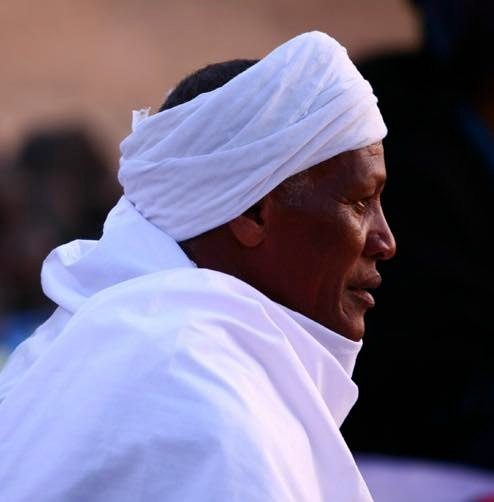
Obbo Dabbasaa Guyyoo was born in the Boorana zone of the Taltalle region and raised in Yaa’abal’ota. For decades, he lived in the Liban plains of Ethiopia, serving as an Argaa Dhageettii—a “seer and listener”—for the Oromo people, preserving and interpreting their history, culture, and collective memory.
Even after relocating to Kenya in his later years due to pressure from Ethiopia’s Derg regime, Dabbasaa remained a pillar of Oromo identity. Until his disappearance at around 80 years of age, he dedicated himself to teaching the Gadaa system, mentoring countless elders and scholars, and serving as a living library of Oromo tradition.
Widely regarded as a Grand Hayyuu (scholar) of Gadaa, Dabbasaa was a foundational reference for anyone researching Oromo indigenous governance, ethics, and history. He established the Argaa Dhageettii Gadaa Oromoo Kenya in Dagoretti, Nairobi, where he educated many in Gadaa principles. His influence crossed continents—from South and North America to Russia and Norway—where he lectured on Gadaa, Oromo culture, and customary law.
Dabbasaa possessed a rare gift: he could narrate history spanning thousands of years with clarity and authority, weaving together story, evidence, tradition, morality, and ritual into a coherent and living heritage. He treated all Oromo elders with equal dignity, honoring both young and old with deep human respect.
Yet, his story takes a haunting turn.
On September 27, 2015, after participating in the Irreecha Birraa (Oromo Thanksgiving) celebrations in Nairobi, Dabbasaa Guyyoo vanished without a trace. To this day, his whereabouts remain unknown—a case that has left a deep wound in the heart of the Oromo nation, in Kenya and across the diaspora.
His disappearance sparked outcry and led to legal proceedings in Kenyan courts, yet no resolution has been reached. The Oromo people worldwide continue to seek answers, justice, and closure.
Dabbasaa’s legacy, however, endures—in the minds of those he taught, in the Gadaa values he upheld, and in the unyielding quest for truth that he embodied.
His life reminds us: A people’s memory is their resilience.
His disappearance reminds us: A elder’s silence is a void that echoes.
We remember his contributions. We demand truth about his fate.
And we pass on the responsibility to seek that truth—from generation to generation.
Let us remember and remind each other.
 Oromedia